

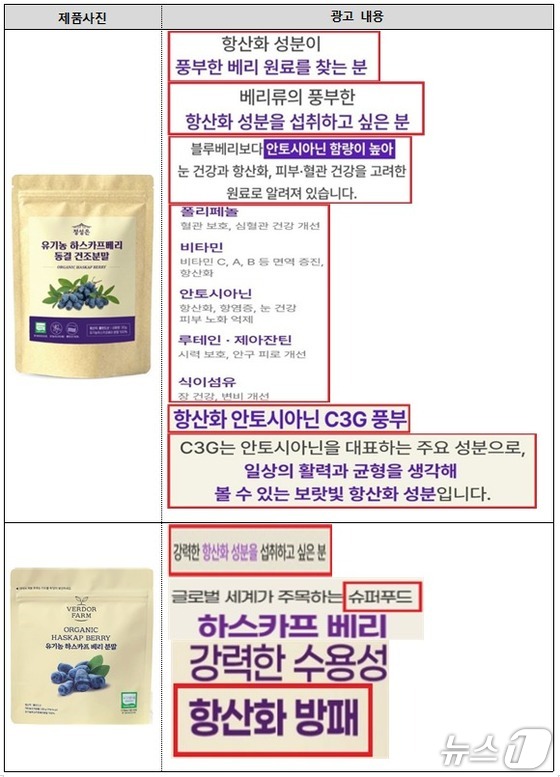
Several companies have been caught misleading consumers by advertising ordinary foods as health supplements with antioxidant or anti-aging properties. The U.S. Food and Drug Administration (FDA) has warned consumers to be wary of such deceptive marketing tactics.
The FDA recently conducted an investigation into online sales of Haskap berry products and albumin supplements, which have been causing increasing consumer harm due to false advertising. As a result, 21 companies were found to be in violation of food labeling and advertising laws. The agency has requested administrative action and initiated criminal investigations against these firms.
Haskap berries, also known as blue honeysuckle, resemble blueberries and belong to the Lonicera genus. The crackdown identified 15 companies selling Haskap berry products and 6 selling albumin supplements. These businesses falsely marketed regular foods as health supplements or claimed they could prevent or treat diseases, generating approximately 14.2 billion KRW (about 9.3 million USD) in sales.
The Haskap berry companies, which sold over 50,000 products worth about 9.4 billion KRW (about 6.16 million USD), used misleading advertisements touting benefits such as antioxidant properties and eye health. They also made false or exaggerated claims about inflammation reduction, disease prevention, anti-aging effects, and improved concentration. Some even deceptively labeled their products as superfoods.
Similarly, the albumin supplement sellers employed misleading tactics, advertising their products as fatigue recovery supplements and blood circulation enhancers. They also made false or exaggerated claims about reducing swelling and used deceptive consumer testimonials. These companies sold around 10,000 products, raking in about 4.8 billion KRW (about 3.15 million USD).
The FDA had previously identified 9 companies for misleading advertising related to albumin products in April. This prompted further inspections after discovering similar violations. It’s important to note that albumin supplements, which use egg whites as their main ingredient, are simply nutrient sources and should not be confused with human serum albumin, a prescription medication administered by injection under a doctor’s supervision.
The FDA emphasized that consumers should not expect the advertised benefits from regular foods, as these products are neither health supplements nor medications. They strongly advised shoppers to exercise caution and not be swayed by advertising claims when making purchases.
As part of a broader initiative to normalize food and drug regulations, the FDA aims to strengthen oversight of misleading food advertisements, focusing on products that garner significant public interest. They plan to respond swiftly to illegal distribution and deceptive advertising practices.
This effort is part of a government-wide program to address and correct abnormal practices and systems entrenched in various sectors of society and administration. The goal is to bring about tangible changes that the public can readily perceive and benefit from.