

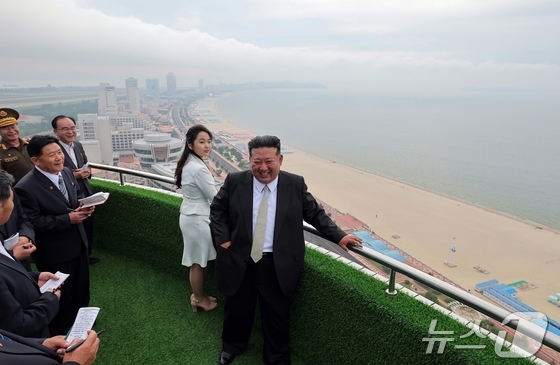
On Thursday, analysts reported that North Korea revamped its tourism strategy following the 9th Workers’ Party Congress held in February.
Lee Ji-sun, a research fellow at the National Security Strategy Institute, recently published a report evaluating North Korea’s tourism policies during Kim Jong Un’s leadership over the past five years. She analyzed the strategic direction and detailed plans proposed by Kim for the development of the Wonsan-Kalma Coastal Tourist Zone and the Samjiyon Mountain Tourist Zone.
At the 9th Workers’ Party Congress in February, North Korea redefined the tourism industry as a new sector driving the country’s economic growth and cultural development. Lee noted that while Kim’s summary report largely omitted the tourism achievements of the 8th Central Committee, the emphasis on tourism activation as a key task in the new economic and foreign strategy was significant.
Lee stated that the core issue of the tourism focus is whether it can yield tangible benefits from improved foreign relations and openness. While tourism currently plays a minor role in North Korea’s economy, it’s worth monitoring whether the new tourism policies can produce better outcomes than before.
The revitalized tourism strategy, emerging around the time of the 9th Party Congress, centers on improving North Korea’s image as a normal and civilized state, expanding economic benefits, and promoting local development.
Lee also highlighted that Prime Minister Pak Thae-song’s inspection of the Samjiyon area in April supports this analysis. Park, who specializes in construction, urban management, and light industry, was involved in the Local Development 20X10 policy established in 2024. His visit to the tourist site can be interpreted as a move to bolster the Cabinet’s implementation of the Supreme Leader’s priority projects.
Lee predicted that North Korean authorities would gradually promote foreign tourism in line with expanding foreign relations and border openings. The initial stage would involve pilot projects with Russian tourists, while the medium term would focus on large-scale resumption and expansion of Chinese tourism to increase revenue.
She estimated that Russian tourist numbers could reach 10,000 to 30,000, potentially generating 100 million to 400 million KRW (about 65,500 to 262,000 USD) annually in foreign currency income, based on per capita spending of 700 to 1,200 USD. Chinese tourism could grow to 300,000 to 500,000 visitors annually, with projected spending of 135 million to 300 million USD.
In later stages, Lee anticipated selective openings to friendly nations and some Western countries, as well as limited cooperation with multilateral organizations. She suggested that signing memorandum of understandings (MOUs) with tourism authorities from countries like Vietnam, Laos, Cuba, Belarus, Cambodia, and Mongolia could boost international cooperation. The recent friendship treaty between North Korea and Belarus has already led to discussions about establishing a Belarusian embassy in North Korea and expanding visa-free entry.
However, Lee identified several constraints, including limited capacity to accommodate large numbers of tourists, inadequate incident response systems, and challenges in regime and image management. She noted that incidents involving foreign tourists could damage North Korea’s international image, posing a significant barrier to foreign tourism growth.
In response to North Korea’s tourism expansion, Lee suggested that South Korea explore indirect cooperation through triangular and multilateral partnerships involving Russia, China, and international organizations. She believes external collaboration is crucial for enhancing North Korea’s tourism capacity, safety training, and infrastructure improvements.
Lee emphasized that in the tourism sector, a development cooperation approach based on normal state-to-state relations would be more appropriate than unilateral support or profit-driven economic cooperation.