

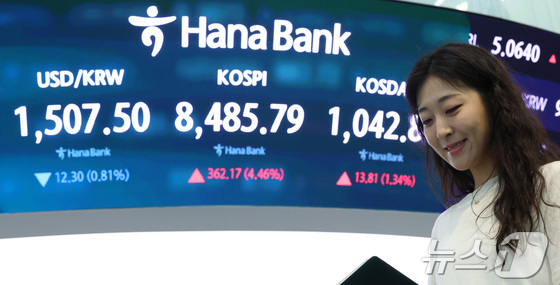
On Monday, Asian stock markets surged following news of a peace agreement between the United States and Iran. South Korea’s KOSPI jumped 5.7% as of 9:44 a.m. (South Korean time), while Japan’s Nikkei soared by 4.9%.
S&P 500 futures rose 0.98%, and Nasdaq futures climbed 1.6%, with European futures also showing modest gains.
Energy prices took a nosedive. Brent crude fell 4% to 83.80 USD per barrel, a significant drop from its May peak of 126.41. USD U.S. West Texas Intermediate (WTI) crude also slipped 4.7%, settling at 80.89 USD.
European natural gas prices plummeted by as much as 5.8%. Market optimism was further boosted by reports that liquid natural gas (LNG) tankers, previously trapped in the Persian Gulf for over three months due to the Strait of Hormuz blockade, had begun moving towards the strait.
Wall Street strategists, according to Bloomberg, predict that Asia will be the biggest beneficiary of this agreement.
Analysts suggest that energy-importing countries such as Japan, South Korea, Taiwan, and India will experience the most significant relief from inflationary pressures due to falling oil prices. While airlines, consumer goods, and technology sectors are expected to benefit, energy stocks may face headwinds.
The anticipated drop in oil prices is likely to ease the pressure on central banks worldwide to tighten monetary policy. Sean Callow, a senior foreign exchange analyst at ITC Markets, told Reuters that the prospect of a sustained decline in energy prices is reshaping discussions ahead of this week’s central bank meetings.
This week, major central banks in the U.S., UK, Japan, Australia, and Switzerland will hold consecutive meetings. Investors have rapidly lowered their expectations for a U.S. interest rate hike this year, with the probability of an October increase now reflected at about 45%. At the Federal Open Market Committee (FOMC) meeting on June 16-17, chaired by Kevin Warsh, the Fed is expected to maintain the benchmark interest rate at 3.50% to 3.75%.
Treasury prices rebounded, with the yield on the 2-year U.S. Treasury note falling 6 basis points to 4.02%. The dollar broadly weakened, with the euro rising 0.4% to 1.1608 USD and the pound gaining 0.3% to 1.3446 USD. The dollar-yen exchange rate dipped 0.2% to 159.90 JPY (about 1.00 USD).
Gold prices climbed 1.9% to 4,300 USD per ounce, buoyed by expectations of lower interest rates. Vivek Dhar, a mining and energy analyst at CBA, told Reuters that Brent crude could fall to 80 USD by year-end, assuming the strait remains open.
However, market participants remain cautious about this rally. Nick Twidale, a senior market analyst at AT Global Markets, told Bloomberg that while much of the negotiations have already been priced into stocks, buying momentum is likely to continue today. He also suggested that the rally might be short-lived.
Dilan Wu, a research strategist at Pepperstone Group, noted that while relief from this agreement is tangible, its success hinges on Israel’s opposition, Iranian hardliners, and the outcome of the 60-day nuclear negotiations.
Adding another layer of complexity is Iran’s announcement that it will jointly oversee ship passage through the Strait of Hormuz with Oman. Although the U.S. stated that free passage would resume, questions have arisen about potential changes to the principles of free navigation in the strait.
Callow commented that the lack of details on shipping liberalization is concerning, but given the current risk-on sentiment, it’s unlikely to significantly impact today’s market. Potential risk factors remain, including the normalization of Strait of Hormuz navigation, delays in supply recovery due to infrastructure damage, Israel’s actions, and the possibility of unexpected moves by Iran-backed proxy forces.