

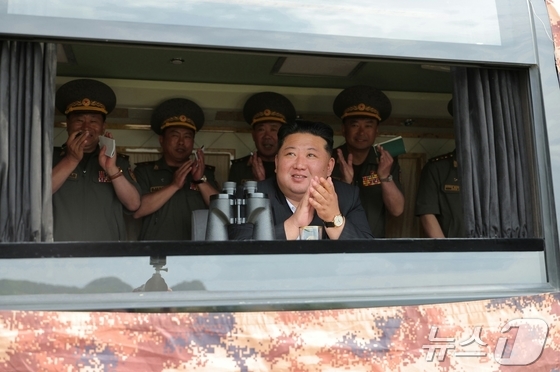
On June 25, marking the 76th anniversary of the Korean War, North Korea ramped up its missile threats against South Korea by testing upgraded weapon systems, including missiles and multiple rocket launchers. Kim Jong Un, the North Korean leader, stated at the launch site that enemies would soon become aware of their long-range missile advancements. Analysts predict that North Korea may soon launch long-range missiles capable of targeting the entire Korean Peninsula.
The Workers’ Party’s official newspaper, Rodong Sinmun, reported on June 26 that Kim observed critical weapon tests conducted by defense research institutes as part of the five-year plan to modernize artillery and missile capabilities.
According to the report, North Korea evaluated the accuracy of enhanced 240mm 24-tube rocket launchers, tactical ballistic missiles with special mission warheads, and extended-range shells (65 km) for 155mm self-propelled howitzers.
North Korea claims that the upgraded 240mm rocket launcher is a corps-level firepower system with automated fire control and a self-guided precision system, increasing its range to 90 km (about 56 miles). They also described the special mission warheads on tactical ballistic missiles as weapons designed to strike key targets such as airfields, ports, and power facilities.
Kim emphasized that this test launch served as a performance evaluation of the improved weapon systems aimed at South Korea. He boasted that their missile systems have advanced enough to precisely strike major facilities and military assets in South Korea, regardless of distance, intending to instill constant insecurity in South Korea.
During the test observation, Kim stated that this test confirms our technological progress in implementing the Party’s military construction policy for our southern border’s firepower posture, as well as the achievement of automation, long-range capability, and ultra-precision. He expressed satisfaction at showcasing a new level of defense development introduced at the 2nd Plenary Meeting of the 9th Central Committee.
He further emphasized that their self-defense policy is not merely about enhancing defensive capabilities, but rather about increasing offensive capabilities to render adversaries incapable of countering. Kim stressed that keeping enemies in a state of constant anxiety and fear is a crucial aspect of deterrence.
Kim also announced plans to ensure enemies become aware of the complete replacement of their long-range strike capabilities with upgraded systems in the shortest time possible. This statement signals the likelihood of upcoming test launches of new missiles, including Intercontinental Ballistic Missiles (ICBMs), Intermediate-Range Ballistic Missiles (IRBMs), Short-Range Ballistic Missiles (SRBMs), Submarine-Launched Ballistic Missiles (SLBMs), and hypersonic missiles, aimed at the East Sea or the West Sea.
If North Korea resumes ICBM launches, which they halted in October 2024, tensions with the U.S. and South Korea are expected to escalate, as ICBMs can target the U.S. mainland with ranges exceeding 15,000 km (about 9,321 miles).
New Five-Year Defense Development Plan: Shifting from Mass Bombardment to Precision Strikes
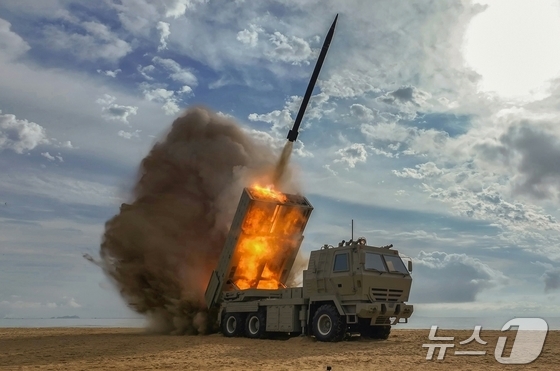
In February, North Korea established a new five-year defense development plan during the 9th Workers’ Party Congress, accelerating the development of new weapon systems. Following the addition of a territorial clause to their constitution in March, they have deployed new short-range ballistic missiles near the demilitarized zone (DMZ) and new cruise missiles, openly threatening a scorched earth strategy against South Korea in case of conflict.
Experts analyze that North Korea is modernizing its forward-deployed corps and transitioning from mass bombardment with conventional weapons like long-range artillery to precision strikes across South Korea using advanced ballistic missile technology, indicating a generational shift in military operations.
During the expanded meeting of the 9th Central Committee from June 20 to 22, Kim emphasized the need to strictly adhere to the Party’s principles of struggle against South Korea, which they consider the most hostile nation. He urged continuous efforts to enhance powerful defense assets, aiming to reach a level that could overwhelm the world, driven by animosity toward South Korea.
On June 6, Kim visited key military supply enterprises with missile chief Jang Chang-ha to assess missile production capabilities in the first half of the year. He directed an increase in ballistic and cruise missile production capacity by 2.5 times within five years. In January, he had also inspected munitions factories, ordering a similar increase in precision-guided munitions production.
As North Korea enhances its missile and warhead capabilities, the frequency of provocations has increased. Up until April, North Korea launched ballistic missiles eight times, starting with a series of SRBM launches into the East Sea on January 4, continuing provocations at intervals ranging from one day to one or two months.
In April, North Korea launched Conditional Restricted Boltzmann Machine (CRBM) Hwasong-11 and Hwasong-11 missiles equipped with cluster munitions and aerial mine dispersal warheads to test new warhead performance.
On May 26, North Korea launched multiple projectiles, including short-range ballistic missiles, into the West Sea. Speculation suggests that these may have been newly developed ballistic missiles with ranges under 300 km (about 186 miles).