

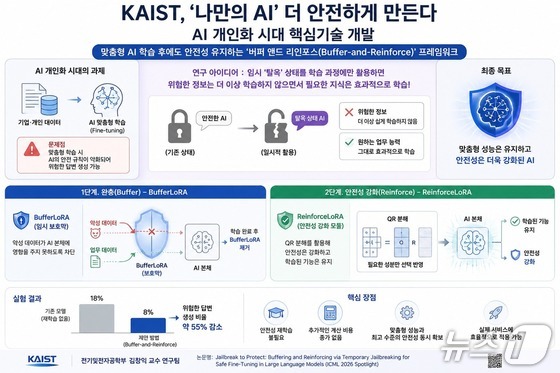
Korea Advanced Institute of Science and Technology (KAIST) announced on Wednesday that a research team led by Professor Kim Chang-Ik from the Department of Electrical and Electronic Engineering has developed a novel learning framework called Buffer and Reinforce.
This innovative approach addresses a critical issue in artificial intelligence (AI) development: the safety concerns that arise when fine-tuning large language models (LLMs) like ChatGPT for specific individuals or businesses.
While customizing AI can significantly boost its performance, it often comes at the cost of weakened safety protocols – a major hurdle in the age of AI personalization.
The team’s breakthrough came from an unexpected direction. They built on previous research suggesting that training AI in a jailbroken state – where it can respond to potentially dangerous requests – doesn’t necessarily compromise safety as much as previously thought.
Instead of using this jailbroken state in real-world applications, the researchers developed a temporary buffer module called BufferLoRA. This module is applied during the customization process and then removed.
The results were striking. AI in this state became more resistant to harmful information while still effectively learning new, user-desired capabilities.
This groundbreaking work marks the first time researchers have demonstrated a way for AI to continue learning necessary information without absorbing potentially dangerous content.
Based on these findings, the team developed a two-step learning technique focusing on buffering and safety enhancement.
First, they apply the BufferLoRA module as a temporary shield, preventing malicious data from directly affecting the AI’s core during customization. Once this process is complete, the module is removed.
Next, they implement a safety enhancement module called ReinforceLoRA. This step boosts the AI’s safety features while preserving the newly learned capabilities.
The team’s experiments yielded impressive results. Even in extreme scenarios where all user data consisted of dangerous questions and answers, the AI maintained high safety standards. After retraining, the rate of generating dangerous responses dropped to about 8% – less than half the 18% rate of the original, untrained model.
Importantly, this method achieves both customized performance and top-tier safety without additional retraining or increased computational costs, making it highly practical for real-world AI personalization services.
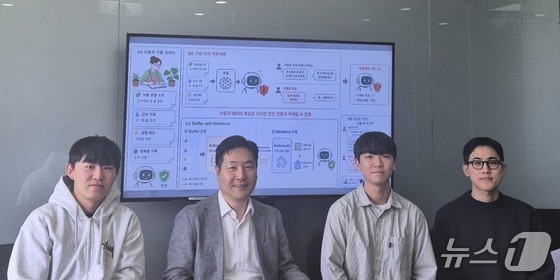
Professor Kim emphasized the significance of their work: This research provides a crucial foundation for democratizing AI. It allows anyone to create personalized AI using their own data, while ensuring enhanced safety. It believes this will play a pivotal role in building a trustworthy ecosystem for AI personalization and AI agents.
Looking ahead, the team plans to expand their research to enable safe personalization in multimodal AI and agent-based AI systems, moving beyond text-based models.
The study, with doctoral student Ham Seok-Il as the lead author, garnered significant attention at the International Conference on Machine Learning (ICML 2026). It was selected as a spotlight paper, placing it in the top 2.2% of all submissions.
This research was supported by the Ministry of Science and Information and Communications Technology’s (ICT) Information and Communication Planning and Evaluation Agency (IITP) under the AI Safety Technology Development Project for Coexisting Trustworthy AI.