


The recent 140 billion KRW (approximately 95.9 million USD) investment agreement between the Ministry of Health and Welfare and Novartis has ignited widespread interest in the radioactive pharmaceutical industry. As precision medicine advances, it promises to maximize treatment efficacy, underscoring the importance of robust infrastructure for production and distribution. This development also highlights the need for close collaboration among government, industry, and academia to drive commercialization efforts.
Radiation Missiles Targeting Cancer Cells With Precision: Maximizing Treatment Effectiveness
A comprehensive report by News1 on Monday reveals that radioactive pharmaceuticals, which incorporate radioactive isotopes, are gaining traction as their global usage expands. Unlike conventional radiation therapy that targets cancerous areas externally, these therapeutic radioactive pharmaceuticals act as radiation missiles, precisely striking only cancer cells.
These innovative treatments, known as Radioligand Therapies (RLT), seek out and attach to cancer cells, emitting radiation that destroys cancerous cells while minimizing damage to surrounding healthy tissue. The Korea Bio Association notes that these therapies enhance the specificity of existing treatments with added precision, offering unique possibilities that set them apart from traditional drug delivery methods.
The field of radioactive pharmaceuticals, a cornerstone of nuclear medicine, has seen significant growth due to its pivotal role in various diagnostics and treatments. With rising cancer rates, the industry has introduced new radioactive pharmaceuticals that boost both diagnostic accuracy and treatment efficacy.
Theranostics, a concept combining diagnostics and treatment, has recently gained momentum. This approach extends the role of imaging tests beyond mere diagnosis to determining treatment options and assessing therapeutic responses.
This aligns with precision medicine’s goal of providing tailored treatments to individual patients. Given that tumor characteristics can vary even among patients with the same cancer type, verifying target expression before treatment has become increasingly crucial.
Professor Ha Seung-kyun from Seoul St. Mary’s Hospital’s Department of Nuclear Medicine emphasizes that moving forward, it’s not just about developing new treatments, but accurately identifying which patients will benefit most from them. The value of Theranostics will grow as clinical evidence and multidisciplinary care systems evolve in tandem.
Novartis leads the charge as SK Biopharm, Duchem Bio, and others accelerate research efforts
The radioactive pharmaceutical market encompasses traditional radioactive therapies and diagnostic and therapeutic radioactive pharmaceuticals (RLT). Novartis holds two therapeutic drugs and Bayer one, though both companies are still in early stages globally. In South Korea, companies like DuChem Bio, FutureChem, and SK Biopharm are spearheading research and development in this field.
While DuChem Bio and FutureChem have diagnostic radioactive pharmaceuticals on the market, their therapeutic options are still in early development. SK Biopharm, meanwhile, is aggressively focusing on the therapeutic sector. The industry anticipates rapid growth in Theranostics and its potential for clinical and business expansion across various disease areas.
On July 21, the Ministry of Health and Welfare and Novartis signed a 140 billion KRW (approximately 95.9 million USD) investment agreement to establish a domestic ecosystem for RLT research and development, production, and treatment. The partnership aims to promote the establishment of domestic manufacturing facilities, expand the number of hospitals capable of administering treatments, and cultivate specialized personnel.
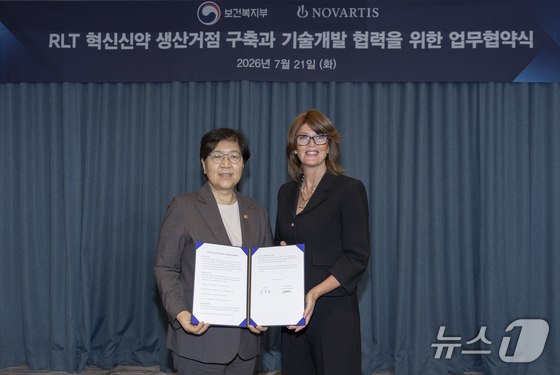
Novartis’s specific plans include establishing domestic manufacturing facilities, building an advanced cold chain logistics network, increasing the number of hospitals administering treatments from 10 to 30, and developing world-class domestic research talent to foster a robust ecosystem.
As a pioneer in this field, Novartis has already commercialized Pluvicto for prostate cancer and Lutathera for neuroendocrine tumors. The company is currently conducting clinical trials to expand treatment coverage to various cancers, including pancreatic, lung, breast, and colorectal cancers.
RLT requires swift action due to the short half-life of radioactive materials, necessitating rapid production, delivery, patient scheduling, and administration processes. Locating production facilities closer to patients can reduce potential supply delays associated with overseas manufacturing and imports.
To this end, Novartis has already established manufacturing facilities in the U.S., Europe, China, and Japan. A facility in South Korea could lower treatment barriers for patients while enhancing domestic production and research capabilities in radioactive pharmaceuticals.
Korea Novartis has remained tight-lipped about the location and timeline for starting production at the domestic facility. A company spokesperson told News1 that this collaboration aims to expand patient accessibility and establish a sustainable RLT ecosystem that it will work closely with the Ministry of Health and other relevant stakeholders to review the process step by step.