

Meta, which operates Facebook and Instagram, has agreed to strengthen youth protection measures in response to lawsuits filed by U.S. state governments alleging the company encourages social media addiction among teenagers. The agreement includes implementing usage time limits, modifying recommendation algorithms, and altering service designs.
In South Korea, officials are considering restricting social media access for users under 14, as well as limiting recommendation algorithms and addictive features like infinite scrolling and autoplay for youth accounts. The focus of youth social media regulations has expanded from age restrictions to encompass service usage methods and platform designs.
Meta to Limit Daily Usage To Two Hours and Block Late-Night Access
On Thursday, Meta agreed to pay up to 16.7 billion USD to settle lawsuits claiming it fosters social media addiction among teens. The company also committed to bolstering protective measures on Facebook and Instagram.
Under the agreement, users under 18 will be limited to a combined total of two hours per day on Facebook and Instagram. The apps will be automatically blocked from midnight to 6:00 a.m.
Users will have the option to view posts from followed accounts chronologically through a non-personalized feed, rather than relying on personalized recommendations. The system will suggest taking a break after 15 minutes of continuous use.
Features that could encourage prolonged use, such as like counts, autoplay, and certain beauty filters, will be restricted. Age verification processes will be strengthened to prevent children under 13 from signing up.
The U.S. agreement is notable for regulating not only age-based access but also usage time, recommendation algorithms, and features that increase user engagement.
South Korea Also Weighing Restrictions on Algorithms and Infinite Scrolling
Similar regulatory discussions are underway in South Korea.
The Korea Media and Communications Commission (KMCC) is reviewing plans to limit social media access for users under 14 and restrict personalized recommendation algorithms and addictive designs for users aged 14 to 19.
Officials are also considering mandating platforms to provide parental supervision features and limit functions that promote continuous use, such as infinite scrolling and autoplay, for youth accounts.
A KMCC official stated that they’re exploring ways to incorporate restrictions on features like infinite scrolling, autoplay, and algorithms for youth accounts, as well as parental supervision capabilities, through amendments to the Telecommunications Act.
The official added that it views Meta’s decision to implement self-improvement measures positively, noting that they are still determining whether these changes will apply globally.
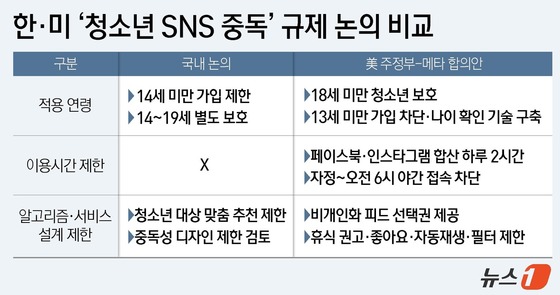
U.S. Focuses on Usage Time Limits, South Korea on Age-Based Restrictions
There are key differences between the U.S. agreement and the measures being considered in South Korea, particularly regarding usage time limits.
While Meta has agreed to limit Facebook and Instagram use for under-18s to two hours daily and block late-night access, South Korea has yet to decide on implementing similar direct usage time restrictions.
Effective age restrictions require robust age verification, which presents challenges. Users may circumvent regulations by providing false information or using others’ accounts. This raises concerns about platforms needing to collect additional personal data for accurate verification.
Imposing direct usage time limits could lead to a balloon effect, with teens migrating to other platforms. South Korea previously abandoned its Game Shutdown System, which restricted late-night gaming for under-16s, due to effectiveness concerns.
A KMCC official noted that the necessity and approach to usage time limits require further discussion, given the differing situations in the U.S. and South Korea.
Experts argue that youth social media regulation discussions should extend beyond age restrictions.
Professor Yoo Hyun-jae from Sogang University emphasized that the U.S. agreement appears to meticulously examine various factors contributing to potential youth harm. He stressed the importance of broadening the discussion to consider how specific social media features and content impact teenagers, rather than focusing solely on age.