

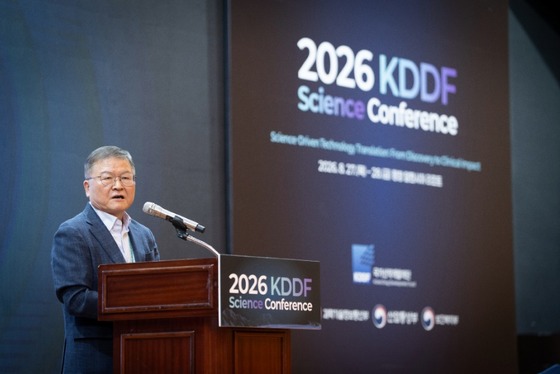
Innovation in drug development isn’t born from a single field of research or one technology alone. It emerges when scientists from diverse disciplines come together to share their knowledge and experiences. Dr. Park Young-min, director of the National New Drug Development Foundation, emphasized the need for collaboration that transcends boundaries between research fields and institutions to drive innovation in the drug development ecosystem. He stressed that translating groundbreaking discoveries in basic science into actual treatments and clinical benefits for patients requires a collaborative approach, where researchers from various fields work together to tackle complex scientific questions.
Dr. Park shared these insights during the 2026 Korea Drug Development Fund (KDDF) Science Conference, held from August 27 to 28 at the Alpensia Resort in Pyeongchang.
The KDDF Science Conference is an academic exchange event that brings together not only participants in national drug development projects but also experts from academia, industry, research institutions, and hospitals across the drug development landscape. To facilitate in-depth scientific discussions, the foundation organizes the conference as an invitation-only event, limited to about 100 participants.
Now in its sixth year, this year’s conference focused on the theme, Transforming Science-Based Technology: From Discovery to Clinical Outcomes. A key topic of discussion was how to effectively translate scientific evidence gathered during the drug development process into tangible therapeutic advancements.
The event attracted over 100 drug development experts from academia, industry, research institutions, and hospitals. The program was structured around four main sessions: △ Discovery and Validation of New Targets; △ Biomarkers and Translational Strategies; △ Platform Technologies; and △ Drug Design with Clinical Outcomes in Mind.
Discussions unfolded across these four key areas: △ Discovery and Validation of New Targets; △ Biomarkers and Translational Strategies; △ Platform Technologies; and △ Drug Design with Clinical Outcomes in Mind.
On the first day, Professor Seok Cha-ok from Seoul National University and Park Seung-beom, Chief Executive Officer (CEO) of Spark Biopharma, shared insights on target discovery, validation, and artificial intelligence (AI) driven research outcomes in drug development. They also introduced translational research leveraging clinical data and spatial biology, as well as novel strategies for identifying therapeutic targets.
The keynote lecture was delivered by Dr. Lee Charles, a professor at the University of Connecticut School of Medicine, who discussed structural variations in complex regions of the human genome.
The second day focused on next-generation platform technologies, including single-cell analysis, targeted protein degradation, and RNA therapeutic delivery. Following this, experts in clinical development and medicinal chemistry shared strategies for bridging the gap between research outcomes and actual treatment development.
Participants engaged in lively discussions on nine key topics: target validation, multi-omics, predictive biomarkers, spatiotemporal disease heterogeneity, novel therapeutic approaches and biological barriers, platform technologies, treatment resistance, clinical benefits, and the translational potential of scientific discoveries.
Each group critically reassessed long-held assumptions and approaches in existing research, identifying areas of expert disagreement and unresolved scientific challenges. This process led to the identification of key scientific questions and research directions that should be prioritized in their respective fields moving forward.
Dr. Park expressed his commitment to ensuring that the KDDF Science Conference continues to evolve as a platform where scientists can engage in deep, cross-disciplinary exchanges, generating new scientific questions that the drug development ecosystem must collectively address.
The National New Drug Development Foundation serves as the dedicated agency for the government’s national drug development initiative, aimed at enhancing domestic competitiveness in this field. It supports research and development throughout the entire cycle, from drug candidate discovery to clinical trials and commercialization. Working in collaboration with the Ministry of Health and Welfare, the Ministry of Science and ICT, and the Ministry of Trade, Industry, and Energy, the foundation supports drug development efforts by domestic pharmaceutical and biotech companies and research institutions through the national drug development project.