

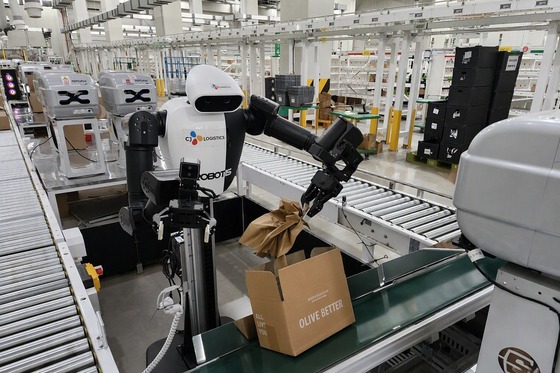
CJ Logistics is ramping up its logistics automation efforts using Physical AI by introducing humanoid robots into actual distribution center operations.
The company is gradually deploying artificial intelligence (AI) humanoid robots, jointly developed with robotics specialist ROBOTIS and Physical AI startup RLWRLD, to its major logistics hubs.
On Thursday, industry sources reported that CJ Logistics has integrated two dual-arm humanoid robots into the packaging process at the Olive Young distribution center in Yangji, Gyeonggi Province.
These robots are tasked with inserting cushioning materials into boxes on the packaging line. This marks the first real-world application of humanoid robots in a logistics setting where workflows vary based on product types, quantities, and packaging requirements.
This deployment builds on last year’s field trial at the Gunpo fulfillment center. In September 2025, CJ Logistics tested ROBOTIS humanoid robots on the Gunpo center’s packaging line to evaluate the operational efficiency and safety of cushioning material replenishment tasks.
Logistics centers present a uniquely challenging environment for humanoid robot applications. Unlike manufacturing lines that produce standardized items in a fixed sequence, distribution centers handle diverse products with varying sizes, weights, and materials. Workloads and processes also fluctuate with seasonal changes, promotional events, and order volume shifts.
While conveyor systems and stationary industrial robots excel at repetitive, standardized tasks, they often require extensive modifications to equipment and workspaces when adding new functions or altering workflows. Humanoid robots, designed to mimic human arms and hands, offer a flexible alternative that can be deployed across various tasks without major changes to existing facility layouts.
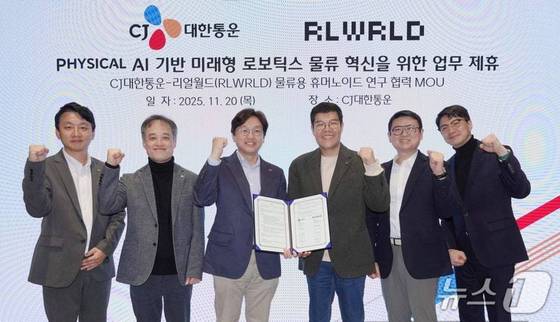
CJ Logistics is focusing not only on robot hardware but also on leveraging operational data from logistics environments to enhance Robot Foundation Models (RFMs).
The company has entered into a partnership with RLWRLD to co-develop logistics-specific RFMs and has made strategic investments in the startup. Their strategy involves training robots using both real-world logistics data and simulated virtual scenarios to develop robotic control systems capable of adapting to diverse product types and working conditions.
Starting with cushioning material insertion, CJ Logistics plans to progressively expand humanoid robot applications to include product picking, sorting, quality control, and packaging. The company aims to create a specialized AI robotics ecosystem for logistics by integrating ROBOTIS’ humanoid hardware, Aidin Robotics’ robotic hands, and RLWRLD’s RFMs.
Kim Jung-hee, Director of CJ Logistics’ TES Logistics Technology Research Institute, stated that this field deployment represents a significant milestone as humanoid robots begin to fulfill operational roles in actual logistics processes. By combining the vast amount of data gathered from the operations with AI technology, it aims to develop humanoids capable of autonomous decision-making and task execution across various functions. The goal is to create a next-generation fulfillment system where humans and robots work seamlessly together.