

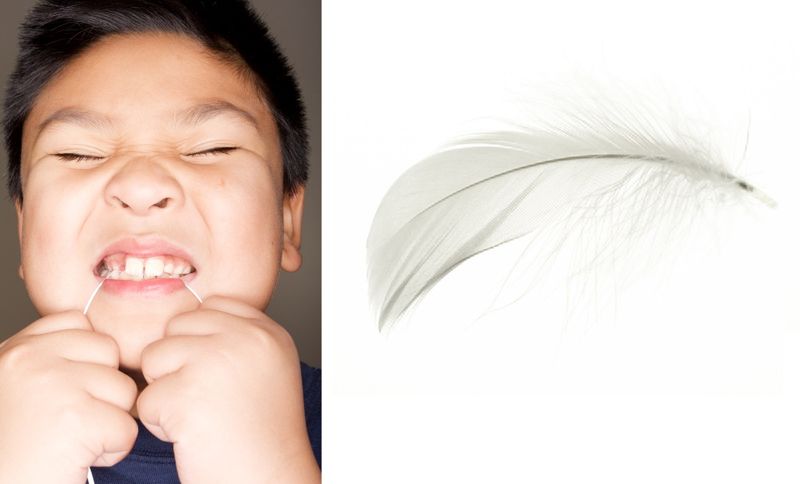
A feather fragment was found embedded in a 12-year-old boy’s jaw.
The international medical journal Cureus reported on Wednesday that a young boy from Riyadh, Saudi Arabia, visited the hospital after experiencing pain in his right jaw while chewing and swallowing.
Upon examination, medical staff observed redness and swelling near the patient’s lower right jawbone. Despite conducting a CT scan, no foreign objects were initially detected.
A feather Stuck in his Gum After Being Used as Dental Floss
The boy admitted to using a feather instead of dental floss to remove food particles from between his teeth about ten days earlier. Based on this information, the medical team decided to proceed with surgery.
During the procedure, surgeons successfully removed a 2 cm (0.4 inches) long fragment of the feather’s shaft. Fortunately, no additional infections occurred, and the patient was discharged the same day with a prescription for antibiotics.
The medical team explained that a part of the feather’s quill – the central shaft from which the barbs extend – had become lodged near the right submandibular duct, a salivary passage located under the tongue, while attempting to clean his teeth.
Dental experts emphasize the use of proper dental floss for removing debris between teeth, rather than improvised alternatives.
Regular flossing is crucial for maintaining oral health. It can reduce the risk of cavities by up to 40% compared to brushing alone. Neglecting to floss can lead to plaque buildup, increasing the risk of tooth decay and periodontitis. In severe cases, bacteria from these infections may spread through blood vessels to other parts of the body.
Choosing the floss with the right thickness is important. For wider gaps between teeth, thicker floss is recommended, while closely-set teeth require thinner floss. Ideally, flossing should be done after every meal before brushing. However, if this proves challenging, flossing at least once before bedtime is recommended.
Individuals with misaligned teeth, gum disease, or gaps that easily trap food particles are especially advised to adopt regular flossing habits to prevent plaque accumulation.
Is It Safe to Floss When Gums Bleed?
Some people avoid flossing due to gum bleeding, fearing it may cause damage. However, bleeding gums often indicate a greater need for flossing.
Healthy gums typically don’t bleed when flossed correctly. Bleeding occurs when plaque and tartar accumulate, causing gum inflammation. Plaque, a white substance composed of food particles and bacteria, can harden into tartar if not removed.
If your gums bleed while flossing, it’s crucial to use floss to remove plaque and tartar from the affected area in order to prevent worsening inflammation. Ignoring bleeding and avoiding flossing can lead to more severe inflammation and potentially progress to periodontitis, a serious gum infection that damages soft tissue and bone.
Consistent flossing to remove tartar should resolve bleeding within one to two weeks. If bleeding persists beyond this period, visiting a dentist is advisable. Older adults are particularly susceptible to gum bleeding since the gums naturally recede and spaces between teeth widen with age, making it easier for plaque and tartar to accumulate.