

A South Korean research team has discovered that the brain may be the starting point of age-related muscle loss, offering fresh insights and a strategic direction for developing targeted therapies.
On Tuesday, the National Research Foundation of Korea announced the findings of a joint study led by Professors Kim Sang Ryong and Lee Jun Young of Kyungpook National University, along with Drs. Nam Young Pyo, Kim Se Hwan, and Kim Jae Gwang of the Korea Brain Research Institute. The researchers demonstrated that dysfunction in the substantia nigra-striatum dopamine neural system is one of the primary causes of muscle mass reduction due to aging.
The nigrostriatal dopamine pathway—a key brain circuit for motor control—has long been recognized as highly susceptible to aging and strongly linked to movement ability. However, a direct causal relationship with muscle loss has not been clearly established until now.
Focusing on this vulnerability, the researchers explored anti-aging interventions targeting this neural system as a novel approach to combat sarcopenia, the progressive loss of muscle mass and strength due to aging.
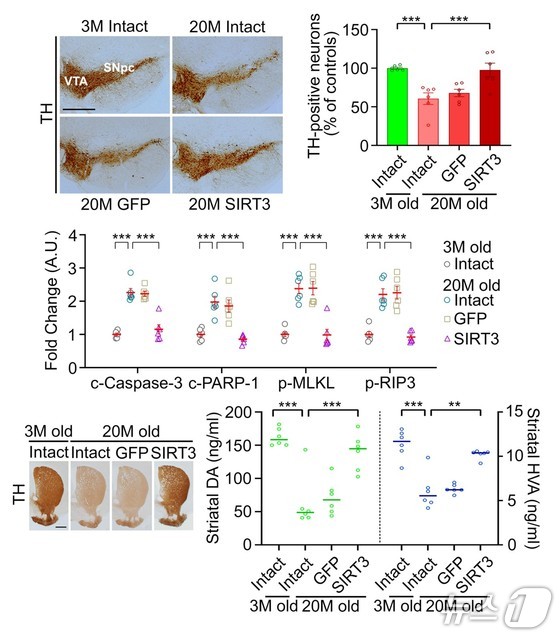
They first observed that the expression of SIRT3, a key anti-aging protein, significantly declines with age in the substantia nigra of elderly mice. By using gene delivery to increase SIRT3 expression in dopamine neurons, they successfully activated mitochondrial function and reduced levels of p16^INK4a, a protein marker associated with aging.
In practical terms, these interventions improved motor performance and helped preserve skeletal muscle mass in the mice. Tissue analysis also confirmed that the treatment protected the neuromuscular junctions, which serve as the communication bridge between nerves and muscles.
Professor Kim Sang Ryong commented, “Our findings show that age-related physical decline and sarcopenia may fundamentally stem from neural degeneration in the brain’s motor systems. We believe this opens a new path toward developing neuroprotective, personalized anti-aging therapies.”
The study was published in the prestigious journal Signal Transduction and Targeted Therapy, focusing on biochemical and molecular biology research.