

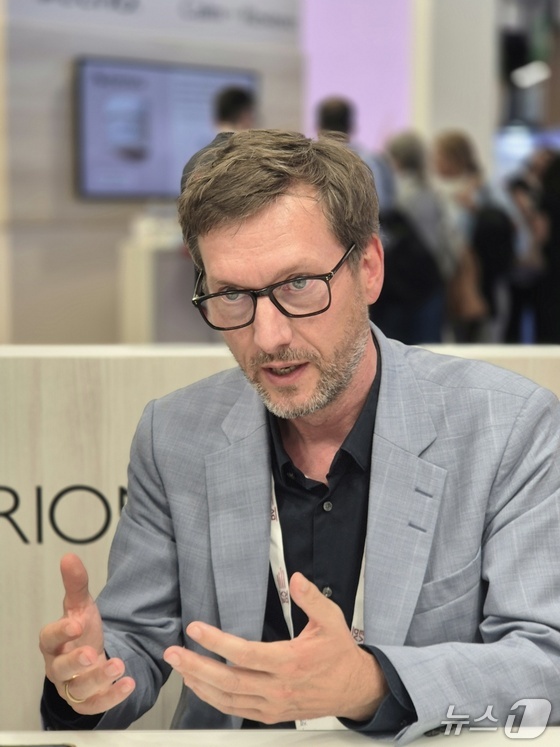
“Biosimilars are more than just generic drugs; they’re game-changers in healthcare, opening doors to treatments previously out of reach for many patients.” This was the key message from Professor Martin Metz of Berlin’s Charité hospital at the 34th European Academy of Dermatology and Venereology (EADV) conference in Paris on September 18. Metz presented groundbreaking Phase 3 data for Omliclo, a chronic spontaneous urticaria (CSU) treatment developed by Celltrion, at a company-sponsored symposium.
“The power of biosimilars in expanding patient access”
Metz emphasized the transformative power of biosimilars in expanding patient access to crucial treatments. He noted the decade-long absence of biosimilars in the CSU field, highlighting how Omliclo’s clinical results—which matched the reference product in both efficacy and safety—could significantly broaden treatment accessibility. While the impact on treatment guidelines may be subtle, Metz argued that the increased availability of treatment options represents a paradigm shift for patients.
The professor also pointed out that despite the emergence of new drugs, omalizumab’s decade-long track record provides a sense of predictability and comfort for both healthcare providers and patients. He stressed that the introduction of biosimilars isn’t just about cost reduction—it’s about dramatically increasing the number of patients who can receive life-changing treatments.
Addressing the current landscape, Metz explained that in some countries, patients bear the brunt of high costs for innovative treatments. He expressed optimism that biosimilars could level the playing field, allowing more patients to access treatments regardless of varying national healthcare systems.
Metz commended Celltrion for its holistic approach, noting that the company goes beyond drug development to invest in patient communities and academic pursuits. He recognized Celltrion’s significant role as a global leader in the biosimilar market.
Celltrion’s CT-P55 and Omliclo Take Center Stage at EADV
Metz’s insights aligned closely with the data Celltrion unveiled at the conference. The company presented its first Phase 1 clinical trial results for CT-P55, a biosimilar to secukinumab, through an e-poster (P3109). The study compared CT-P55 to the original secukinumab in healthy adult males.
The trial design involved a single 150 mg subcutaneous injection with a 22-week follow-up period. Participants were randomly assigned in equal groups to receive CT-P55, EU-approved secukinumab, or US-approved secukinumab. The study confirmed equivalence in key pharmacokinetic parameters: AUC0-inf (total drug exposure over time) and Cmax (peak blood concentration). Safety profiles and immunogenicity were also comparable to the reference product, establishing equivalence across all three critical domains.
Building on these promising Phase 1 results, Celltrion is advancing to a global Phase 3 trial involving 375 patients with moderate to severe plaque psoriasis. With European IND approval already secured and trials underway, Celltrion aims to leverage its strong position in the autoimmune and oncology markets to make significant inroads in dermatology.
Omliclo, the focus of Metz’s presentation, also garnered significant attention at the conference. During the September 18 symposium, Metz shared data from the global Phase 3 trial, including 40-week follow-up results, which demonstrated Omliclo’s safety and efficacy in CSU patients. This data has been hailed in major medical journals and international media as the first large-scale evidence supporting an omalizumab biosimilar.
The introduction of Omliclo promises to expand the limited treatment options previously available to CSU patients. As it enters the market, patients will have more choices, potentially benefiting a larger population. European dermatology experts anticipate that the combination of omalizumab and its biosimilars, alongside new drugs, will usher in a multi-faceted approach to treatment.
Throughout the EADV conference, speakers repeatedly emphasized that biosimilars represent more than just cost savings—they offer hope for treating more patients. Metz reiterated this sentiment, underscoring that biosimilars are powerful tools for broadening patient access to critical treatments.