

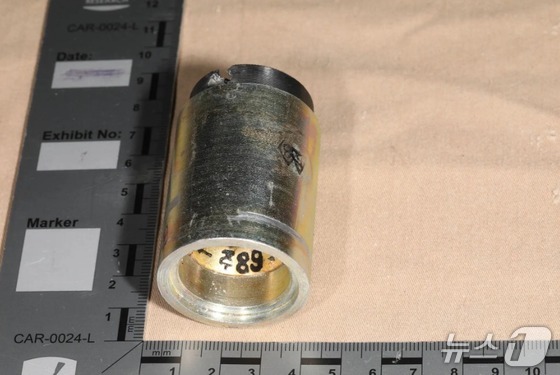
On Monday, evidence emerged that cluster munitions supplied by North Korea to Russia have been modified into drone warheads and deployed on the Ukrainian battlefield. While previous reports confirmed that North Korea’s military aid to Russia primarily consisted of artillery shells and missiles, this is the first indication that cluster munitions have been provided.
The Conflict Armament Research (CAR), a UK-based weapons tracking organization, revealed in a recent report that Russian forces have been using small drones armed with North Korean cluster munitions to target southern Ukraine.
The report states that on September 23, Ukrainian authorities recovered a small bomb from a First-Person View (FPV) drone employed by Russian forces. The bomb was marked Juche 89 (2000), suggesting it was an older type of ammunition produced in North Korea. The munition had been modified with a three-dimensional (3D) printed electronic detonator designed to detonate upon impact with the target.
CAR analysts believe this bomb is likely a North Korean replica of the munitions used by U.S. forces during the 1991 Gulf War. The report emphasizes that the discovery of these modified North Korean bombs in FPV drones exemplifies a growing trend on the battlefield of augmenting existing supplies with improvised capabilities.
This development is particularly noteworthy as it suggests that North Korea’s military support extends beyond merely supplying shells and missiles, indicating a deeper integration with Russia’s tactical weapons systems.
If confirmed, North Korea’s provision of cluster munitions would clearly violate international humanitarian law and United Nations (UN) Security Council resolutions. Due to their potential to cause widespread civilian casualties, over 120 countries have signed a treaty banning cluster munitions. Neither North Korea nor Russia is a signatory to this agreement.