

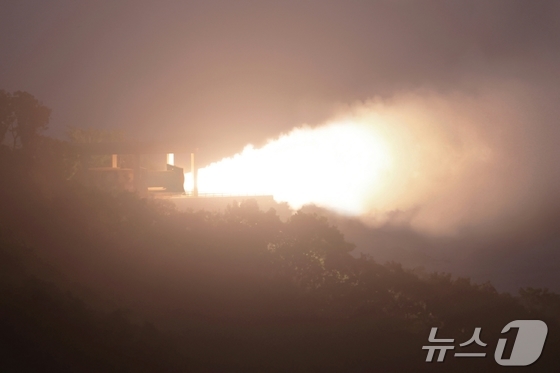
Recent analysis suggests that North Korea has conducted engine tests at the Dongchang-ri satellite launch site on the west coast, a facility known for developing intercontinental ballistic missiles (ICBMs) and long-range missile launch vehicles. On Wednesday, experts speculated that these tests could be preparations for the upcoming launch of the new ICBM Hwasong-20, which was first unveiled on October 10.
The U.S.-based North Korea monitoring website 38 North released this analysis based on satellite imagery captured from late September to early October.
38 North reported that images from September 27 showed a mobile crane at the vertical engine test stand (VETS), with the existing mobile structure moved back. Several carts loaded with hoses and cables were visible on a nearby runway. By September 29, the mobile structure had returned to the test stand.
Images from October 4 revealed orange residue and burn marks at the launch pad’s exhaust outlet. 38 North analysts believe that the orange residue likely derived from oxidizers such as nitric acid and nitrogen tetroxide used in the engine tests, while the burn marks resulted from cooling the engine exhaust.
These activities suggest that North Korea may be preparing for an imminent test launch of the Hwasong-20. This missile is reportedly designed with a range of approximately 15,000 km (about 9,320 miles) , making it capable of striking the U.S. mainland.
On the same day, around 8:10 a.m. (South Korean time), North Korea launched several projectiles—believed to be short-range ballistic missiles (SRBMs)—in a northeastern direction from the Junghwa area in North Hwanghae Province. This launch occurred just a week before President Donald Trump’s scheduled visit to South Korea for the Asia-Pacific Economic Cooperation (APEC) summit and is seen as a move to disrupt dialogue with the U.S.
If North Korea proceeds with launching the Hwasong-20 before APEC, it would send an even more forceful strategic message to the U.S. This action could also be interpreted as an attempt to increase its leverage in future negotiations by enhancing its nuclear card.
Experts note that North Korea has never failed to conduct a test launch after unveiling a new ICBM or its components, leading to high expectations for a test launch by the end of the year.
Alternatively, these activities could be related to preparations for launching military reconnaissance satellites. North Korea claimed to have successfully placed its first military reconnaissance satellite, Malligyong-1, into orbit in November 2023 and announced plans for three additional satellite launches. However, following a failed launch attempt in May last year, no further developments have been observed.
38 North also reported ongoing expansion and modernization efforts at the West Sea satellite launch site. Construction is underway to connect a tunnel entrance linking the launch site to a nearby coastal road, and a new port being built near the launch site is nearing completion.
The West Sea satellite launch site, also known as the Dongchang-ri launch site, is located in North Pyongan Province and is believed to have been completed around 2008.
The facility is equipped with a vertical launch pad for large vehicles, a launch pad for smaller vehicles, an engine combustion test facility, and underground infrastructure for fueling large missiles and rockets.