

Shockwaves rippled through the U.S. intelligence community as reports surfaced of a high-ranking Chinese military official allegedly passing nuclear secrets to American authorities.
The Chinese military’s influence over the Communist Party cannot be overstated, as evidenced by the famous quote from the party’s founder, Mao Zedong: Political power grows out of the barrel of a gun.
Even Deng Xiaoping, often referred to as China’s Paramount Leader, held onto the chairmanship of the Central Military Commission as his final official title.
The current leadership structure of the Central Military Commission includes Xi Jinping as chairman, Zhang Youxia as first vice chairman, and He Weidong as second vice chairman.
In keeping with the principle of Party supremacy, Xi, a civilian, holds the top military position as chairman of the commission.
The commission consists of seven members, with Xi being the only non-military figure. Among the uniformed members, Zhang holds the highest rank.
On January 25, The Wall Street Journal (WSJ) broke the story, reporting that this high-ranking official’s alleged transfer of critical nuclear technology to the U.S. has sent tremors through Beijing’s power corridors.
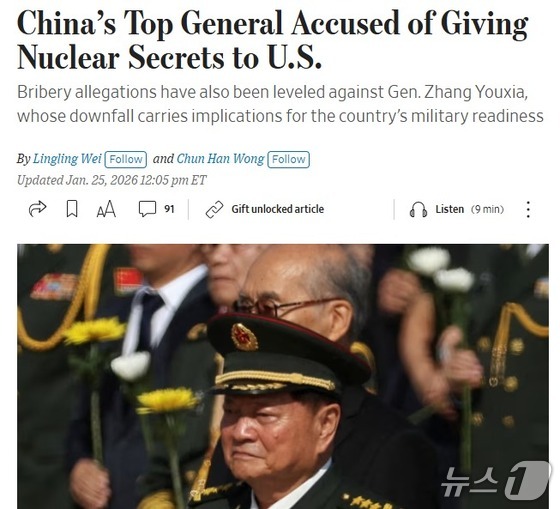
According to WSJ’s well-placed sources, while General Zhang was initially thought to have been ousted due to corruption charges, the real reason for his dramatic fall from grace was the alleged transfer of nuclear secrets to the U.S.
The allegations against Zhang came to light during the investigation of Gu Jun, Chief Executive Officer (CEO) of the China National Nuclear Corporation, a state-owned enterprise overseeing both civilian and military nuclear programs.
It’s worth noting that Zhang, like Xi, belongs to the influential Princelings faction. His father, Zhang Zhongxun, was a revolutionary veteran who fought alongside Xi’s father, Xi Zhongxun, in the Northwest Field Army during the Chinese Civil War.
Since Xi’s ascension to power, Zhang has been instrumental in consolidating military control and was widely regarded as one of Xi’s most trusted lieutenants.