

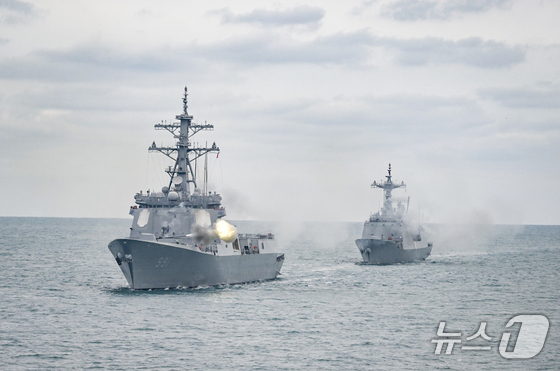
South Korean Navy’s next-generation maritime intelligence vessel (AGX-III) program, designed to serve as the eyes and ears of the fleet, is picking up steam. The U.S. Navy aims to bolster its maritime surveillance capabilities against underwater threats, including North Korean submarines, by expanding its fleet of intelligence-gathering ships from two to four by the mid-2030s.
Defense industry sources reported on Friday that the Defense Acquisition Program Administration has issued a call for bids to select a company for the basic design of the new intelligence vessel. Interested parties can submit their applications until March 22, with a project briefing scheduled for March 10.
The basic design phase for the AGX-III is set to last 26 months from the contract signing date, with a budget of approximately 27.4 billion KRW (about 18.5 million USD). The contract will be awarded through a competitive bidding process.
While not heavily armed, these intelligence vessels are crucial strategic assets in modern naval warfare, specializing in information gathering. They collect and analyze acoustic data, marine and meteorological information, and electromagnetic signals to produce actionable intelligence and support naval operations.
The Navy currently operates two intelligence-gathering ships: the Shinsegi (AGS-12), commissioned in 2003, and Shinkiwon (AGS-13), which entered service in 2012. These classified assets displace 2,800 and 3,500 tons, respectively. A smaller 1,000-ton vessel, the Sincheonji (AGS-11), was decommissioned in December 2013 after two decades of service.
Military analysts have long criticized the insufficient number of these specialized vessels, which limits the Navy’s ability to conduct simultaneous intelligence operations in both the East and West Seas. The rapid advancement of North Korea’s naval capabilities, coupled with increased Chinese and Russian naval activity in nearby waters, underscores the need for enhanced data collection on potential adversaries.
A defense industry expert noted that compared to China’s fleet of 12 intelligence ships and Japan’s six, its Navy faces a significant numerical disadvantage. With the current vessels aging past the 10-year mark, it’s critical that it pursues this next-generation program to maintain the intelligence edge against North Korea.
The basic design contract marks the initial phase of the project, to be followed by detailed design and construction. The Navy plans to invest approximately 1.94 trillion KRW (about 1.3 billion USD) to acquire two new intelligence vessels, each displacing over 4,000 tons, by 2035.
The competition for this lucrative contract is expected to be fierce among major shipbuilders with expertise in specialized vessel construction. Industry insiders suggest that HD Hyundai Heavy Industries, which completed the concept design, is a frontrunner. However, potential security concerns related to their involvement in the Korean Destroyer Experimental (KDX) program could complicate matters. Hanwha Ocean is also considered a strong contender for the bid.
A senior defense analyst commented that doubling the intelligence fleet from two to four vessels will significantly enhance the mission sustainability and operational reach. It’s crucial that it carefully defines the operational concepts during the basic design phase and ensure a transparent bidding process to avoid delays in this critical capability upgrade.