

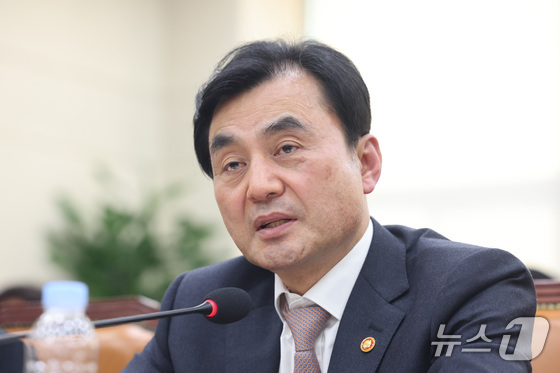
Ahn Gyu-back, the defense minister, told the National Assembly on Tuesday that Seoul has not received any formal request from the United States to deploy forces to the Strait of Hormuz following President Donald Trump’s public call for allies to send ships there.
By contrast, Foreign Minister Cho Hyun—who spoke by phone with U.S. Secretary of State Marco Rubio the day before—told lawmakers he could not publicly say whether Washington had made a formal or informal deployment request, highlighting a subtle split between the foreign ministry and the defense ministry.
Ahn Gyu-back: We Don’t Regard SNS Messages as Formal Requests… No U.S. Request Received
At the Defense Committee’s full session at 3:00 p.m. (South Korean time), Ahn was asked by Rep. Seong Il-jong (People Power Party), Have you received a deployment request, or are you reviewing one?, he replied that no official request has been received.
Beginning on March 14, President Trump used the social media platform Truth Social over two days to urge seven countries, including South Korea, to dispatch naval vessels to the Strait of Hormuz.
Ahn said that he doesn’t regard a social media message as an official request. To date, it has not received any request from the U.S.
When Rep. Jung Cheong-rae (Democratic Party) asked whether Seoul should be preparing contingency plans even before a formal request arrives, Ahn said internal reviews are under way but those deliberations are not matters for public disclosure.
On the related safety question—if South Korean forces were to operate in the Strait of Hormuz, wouldn’t they face significant risk?—Ahn noted that the Cheonghae Unit’s anti-piracy mission in the Gulf of Aden differs fundamentally from operations in the Hormuz environment. He said significant additional preparations would be required and declined to confirm whether the Cheonghae Unit is being considered for deployment.
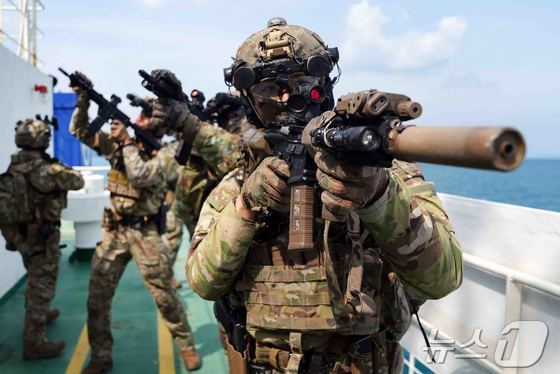
Acknowledges Lightly Armed Concerns for Cheonghae Unit in Actual Deployment… Many Shortfalls in Weapon Systems
Rep. Im Jong-deuk (People Power Party) asked what constitutes a formal request to deploy forces to the Strait of Hormuz. Ahn replied that such a request would normally follow an official exchange of documents or minister-level consultations; no such procedures or requests have occurred, he said.
Im warned that public debate centers on whether the Cheonghae Unit—now configured mainly for anti-piracy, light-armed operations—could handle a combat mission. Im said that if the unit were to enter combat, that’s a completely different matter. Ahn agreed, saying that the weapons systems are limited and many capabilities are lacking.
Rep. Yoo Yong-won argued that the unit’s current armament in the Gulf of Aden would make participation in a U.S.-led escort operation hazardous.
Yoo said the Daejoyeong-class destroyer’s configuration is optimized for anti-piracy duties and is therefore inadequate for higher-threat operations. He added that Iran possesses significant drone capabilities, leaving the unit vulnerable and making deployment of the destroyer as-is a substantial risk.
Ahn said sending forces under their current mission posture and force condition is not being considered.
Yoo asked whether even an Aegis-equipped ship would require upgrades or counter-drone measures and warned that transit would take three to four weeks plus preparation time. Ahn said the navy must assess ship readiness but estimates preparations would take more than a month.
When Rep. Han Ki-ho asked whether parliamentary approval would be required for deployment, Ahn replied that, under Article 60(2) of the Constitution, deployment requires National Assembly consent.
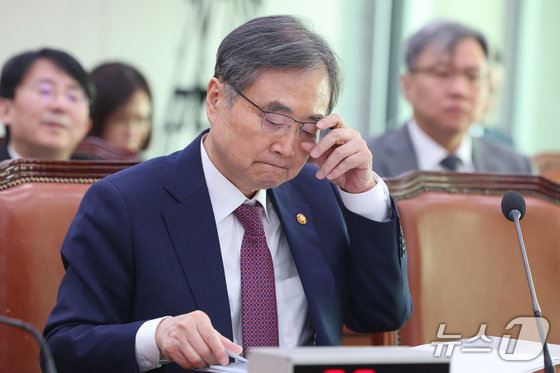
Cho Hyun Says Disclosure of Deployment Request Difficult… Stresses Maintaining Strategic Ambiguity for National Interest
At the Foreign Affairs and Unification Committee hearing, Cho said he could not publicly disclose whether the U.S. had made a formal request for forces to be sent to the Strait of Hormuz.
Cho told lawmakers that, in his call with Rubio the previous night, Rubio stressed the need for multinational cooperation to secure long-term safety in the Strait of Hormuz and stabilize the global economy and oil markets. Some observers have read Rubio’s remarks as a U.S. request for Korean forces.
Cho said he could not equate the call’s language with a formal deployment request. He said that it’s ambiguous, it could call it a request—or it could not.
Cho added that G7 foreign ministers will meet in Paris on March 25 and that South Korea has been invited; he expects to meet with Secretary Rubio if both attend.
Responding to Rep. Lee Jae-kang’s call to resist unilateral pressure from President Trump and to proceed with extreme caution, Cho said the government will maintain ambiguity publicly and abroad, prioritize national interest and the lives of citizens, and follow constitutional and legal procedures.
Cho emphasized that the safety of international sea lanes and freedom of navigation serve every nation’s interests and are protected by international law. He said the government will keep options open and respond in ways consistent with the Constitution and international norms.
He added that it will prioritize national interest and will not take sides for any particular country.
The government is weighing whether to treat President Trump’s public comments—which came without formal exchanges between the State Department, the foreign ministry, or U.S.-Republic of Korea (ROK) defense channels—as an official request.
For now, both the Defense Ministry and the Foreign Ministry say they have not received any official U.S. deployment request. They are monitoring the situation closely and conducting careful reviews.