

Analyzing the latest research trends reveals fascinating possibilities. When prompted to investigate the effects of anesthetics and analgesics on the human body, an artificial intelligence (AI) system generates over 100 testable research hypotheses. It even provides supporting literature to verify AI’s potential for deception or hallucinations.
This scenario exemplifies the cutting-edge landscape of AI-driven biomedical research. As part of the government’s K-Moonshot initiative to address national challenges through AI, officials are engaging with companies at the forefront of the AI-bio sector.
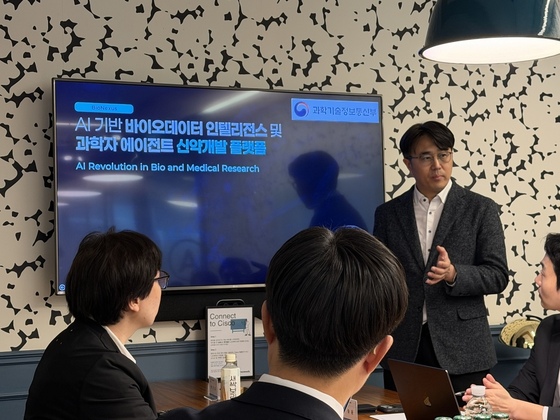
On Thursday afternoon, Deputy Minister of Science and Information and Communications Technology (ICT) Koo Hyuk-jae visited Bionexus, a pioneering AI bio platform company.
During the visit, AI scientists showcased their groundbreaking work in the biomedical field. By automating fundamental research stages, such as hypothesis generation, they’re dramatically reducing time and costs. These AI-generated hypotheses undergo rigorous ethical and biological scoring, competing for top rankings in a process that mimics peer review.
Bionexus is developing an AI scientist platform with the ambitious goal of slashing analysis time by 80%. This platform aims to revolutionize research, diagnosis, and treatment processes, making them faster, more precise, and widely accessible.
In a strategic move, Bionexus is collaborating with Rebellion, a domestic AI semiconductor company, and Upstage, an AI startup developing proprietary foundation models. Their joint objective is to create integrated AI products. By leveraging Rebellion’s neural processing units (NPUs) and Upstage’s AI models, they plan to launch a cost-effective, optimized AI scientist platform in the first half of this year. This initiative aims to democratize AI access for researchers, offering a more affordable alternative to the high-cost graphic processing unit (GPU) infrastructure.
The company is fostering robust partnerships with key domestic research institutions, including the Korea Basic Science Institute and the Korea Bioengineering Research Institute.
Bionexus Chief Executive Officer (CEO) Kim Tae-hyung reflected on the AI landscape, saying that a decade ago, when AlphaGo emerged, there was speculation that within ten years, it’d see superhuman AI tackling complex scientific challenges beyond just playing Go. That future is now. This year, it expects AI to solve intricate scientific problems that previously required once-in-a-century geniuses like Albert Einstein.
Deputy Minister Koo emphasized the project’s significance, stating that as part of the high-risk, high-return K-Moonshot initiative, they’re targeting 12 national missions across eight critical fields. AI-bio is a cornerstone of this effort. While statistically, developing a new drug annually seems impossible, it anticipates unprecedented advancements in biomedical research through AI integration.