

Donald Trump, the President of the U.S., hinted at plans to leave Iran six weeks after the onset of conflict, causing U.S. stock index futures to surge by about 1%, while international oil prices have begun to decline.
As of 12:50 p.m. (South Korean time) on Tuesday, Dow futures rose by 0.96%, S&P 500 futures increased by 0.92%, and Nasdaq futures climbed by 0.88%. Such a nearly 1% rise in index futures is considered significant.
In response to the rebound in index futures, Asian stock markets, which initially opened sharply lower, have significantly reduced their losses.
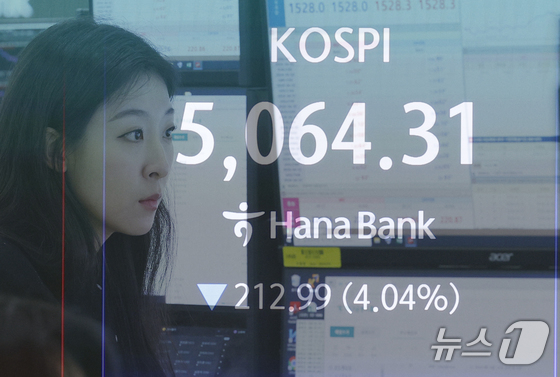
At the same time, Japan’s Nikkei dropped by 0.45%, Korea’s KOSPI fell by 2.99%, Hong Kong’s Hang Seng Index decreased by 0.37%, and China’s Shanghai Composite Index declined by 0.38%.
Meanwhile, Australia’s ASX turned around with an increase of 0.85%.
The KOSPI recorded the largest drop; however, it managed to reduce its decline from over 4% at the market’s open. In contrast, international oil prices are uniformly falling.
In Asian trading, West Texas Intermediate (WTI) futures dropped by 0.16% to 102.84 USD per barrel, while Brent crude futures fell by 0.23% to 112.52 USD per barrel.
Earlier, WTI had surged by more than 5%, reaching as high as 114 USD.
On the same day, President Trump threatened on his Truth Social platform that if an agreement with Iran does not materialize, he would launch devastating attacks on Iran’s power plants and desalination facilities. He also confirmed that the military operation schedule remains unchanged at 4 to 6 weeks.
Speculation is rising that if a dramatic ceasefire agreement does not occur next week, he may be considering a victory declaration after a large-scale attack. Consequently, expectations for an early end to the war are rapidly increasing, leading to a stock market rebound and a drop in oil prices.