

Onconic Therapeutics announced on Monday at the 2026 American Association for Cancer Research (AACR 2026) conference in San Diego that it presented preclinical research results for its next-generation synthetic lethality-based dual inhibitor cancer drug candidate, Nesuparib, in metastatic pancreatic cancer.
The presentation garnered attention for demonstrating Nesuparib’s ability to simultaneously suppress cancer metastasis and exhibit anti-cancer effects independent of BRCA gene mutations, surpassing the limitations of existing PARP inhibitors.
Pancreatic cancer is notorious for its rapid metastasis and extremely limited treatment options, with a five-year survival rate of just over 10%. The survival rate plummets to a mere 2-3% when the cancer metastasizes, underscoring the urgent global need for innovative treatment strategies.
Unlike conventional PARP inhibitors, Nesuparib is designed as a first-in-class cancer candidate that simultaneously targets PARP inhibition and Tankyrase inhibition. Existing PARP inhibitors have shown limited effectiveness, primarily in patients with DNA repair defects such as BRCA mutations. In South Korea, only about 5% of pancreatic cancer patients are known to carry BRCA mutations.
In contrast, this study revealed Nesuparib’s anti-cancer effects and metastasis suppression in pancreatic cancer models without BRCA mutations (wild-type), suggesting its potential to benefit a broader patient population.
Notably, the presentation highlighted another of Nesuparib’s unique mechanisms: its direct inhibitory effect on cancer metastasis. Research indicates that Nesuparib regulates the Hippo signaling pathway through Tankyrase inhibition, suppressing yes-associated protein (YAP) activity, which promotes cancer cell movement and invasion. YAP is a key factor in epithelial-mesenchymal transition (EMT), a critical stage in cancer metastasis where cancer cells transition from a stationary epithelial state to a highly mobile mesenchymal state.
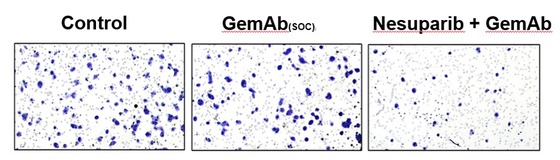
This mechanism was functionally validated through subsequent experiments. In migration and invasion tests using pancreatic cancer cell lines, Nesuparib reduced cancer cell mobility and invasion capabilities through Tankyrase inhibition. When combined with the standard treatment gemcitabine/nab-paclitaxel, Nesuparib demonstrated significantly greater inhibitory effects compared to gemcitabine/nab-paclitaxel alone.
Xenograft animal models consistently reproduced these results, showing reduced expression of EMT-related genes and supporting Nesuparib’s potential to inhibit cancer metastasis. In pancreatic cancer xenograft models without BRCA mutations, the combination of Nesuparib with standard treatment reduced tumor size by 79%, more than double the efficacy of gemcitabine/nab-paclitaxel alone, which achieved only a 31% reduction.
Nesuparib is currently undergoing Phase 2 clinical trials as a first-line treatment for advanced and metastatic pancreatic cancer.
An Onconic Therapeutics spokesperson stated that Nesuparib has demonstrated the potential to overcome the limitations of existing pancreatic cancer treatments through its dual Tankyrase/PARP inhibition mechanism. This approach simultaneously induces DNA damage and regulates Hippo signaling to inhibit cancer growth and metastasis. We anticipate that Nesuparib will offer a promising new treatment option for metastatic pancreatic cancer patients, regardless of their BRCA mutation status.