

AriBio has inked a global licensing deal worth up to 7 trillion KRW (approximately 4.67 billion USD) with China’s Puxing Pharmaceutical. The company plans to unveil the top-line results of its oral Alzheimer’s treatment AR1001 from global Phase 3 clinical trials this September or October.
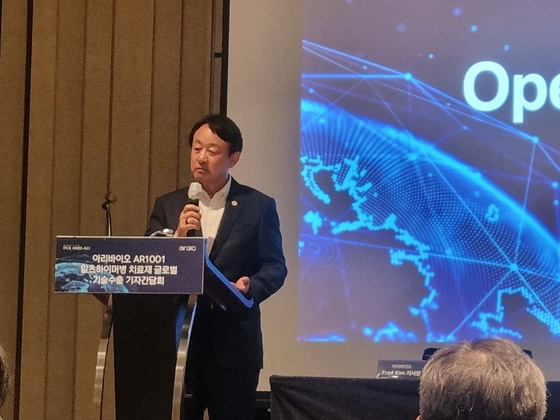
At a press briefing held at the Fairmont Ambassador Seoul in Yeouido on Tuesday, AriBio shared details about AR1001’s global Phase 3 trial progress, the structure of their agreement with Puxing Pharmaceutical, and their future commercialization strategy.
The exclusive licensing agreement with Puxing Pharmaceutical covers global development, approval, production, and commercialization of AR1001. The deal could be worth up to 4.7 billion USD. AriBio will receive an initial 60 million USD option fee, followed by an additional 80 million USD after the Phase 3 top-line results announcement. Subsequently, they’ll receive milestone payments for approval and commercialization stages, plus royalties of up to 20%.
AriBio emphasized that this agreement allows them to establish a global commercialization framework ahead of completing AR1001’s Phase 3 trials. While AriBio will spearhead the final stages of Phase 3 trials and the U.S. Food and Drug Administration (FDA) approval process, Puxing Pharmaceutical will handle funding, production, supply chain, regulatory approvals, and commercialization efforts.
Jeong Jae-jun, co-Chief Executive Officer (CEO) of AriBio, stated that to become a global player, it needs to break away from the notion that Korean biotech firms can only transfer technology to multinational pharmaceutical companies during early clinical trials or at best, Phase 2. Leading global Phase 3 trials is crucial to becoming a key player in global drug development.
Jeong highlighted several factors that influenced their choice of Puxing Pharmaceutical, including the company’s keen interest in Alzheimer’s disease, its ambition to become a global pharmaceutical giant, and its understanding of AriBio’s position.
He added that Puxing’s proposal is significant beyond mere capital injection, especially given the rising costs of clinical trials due to currency fluctuations. While it initially aimed to complete trials and commercialize directly, and it’s unfortunate we transferred global rights before finishing Phase 2, completing Phase 3 is still a major achievement.
Jeong further stated that it plans to share the 16 years of clinical and bioplatform expertise with other Korean companies, paving the way for their commercialization efforts. The ultimate goal is to become South Korea’s leading new drug company.
AR1001 is an oral Alzheimer’s treatment candidate from the PDE-5 inhibitor class. The global Phase 3 trial, dubbed POLARIS-AD, is currently underway with 1,535 patients participating at over 230 clinical centers across 13 countries, including the U.S., Europe, UK, China, and South Korea.
AriBio aims to complete dosing for the last patient by next month. As of May 17, 80 patients remain in the main clinical trial, with the final patient expected to conclude their participation in China. The company plans to announce the top-line results in September or October after completing data cleaning and the database lock process.
The company also reported that over 1,200 patients are participating in extended trials, with more than 110 patients having completed two years of dosing. AriBio is considering treatment use and an Expanded Access Program.
Dr. Kim Sang-yoon, a neurology professor at Bundang Seoul National University Hospital, noted that alzheimer’s disease accounts for 70% of all dementia cases. Until recently, only temporary cognitive enhancers were available. A few years ago, the first treatment to slow disease progression emerged, but it came with significant side effects and high costs.
He added that if AriBio’s new drug succeeds, it would be a game-changer. Being an oral medication, it may have fewer side effects.
Fred Kim, head of AriBio’s U.S. branch, stated that it plans to announce the top-line results and submit our approval application this year. The 2027-2028 period will likely see global approvals, product launches, and the start of royalty revenues. He added that the goal is to surpass 1 trillion KRW (approximately 699 million USD) in annual revenue by 2030.
Lee Byung-gun, special advisor to AriBio, predicted that if this drug succeeds, it will elevate the country’s drug development capabilities to a new level. FDA approval could be possible as early as next year. He emphasized that additional funding is still needed, highlighting the potential for support from sources like the National Growth Fund.
Regarding the merger with Solux, Co-CEO Seong Su-hyeon commented that while the merger is progressing, we’re exploring various options, including standalone listings. It’s considering listings on both KOSDAQ and KOSPI.