

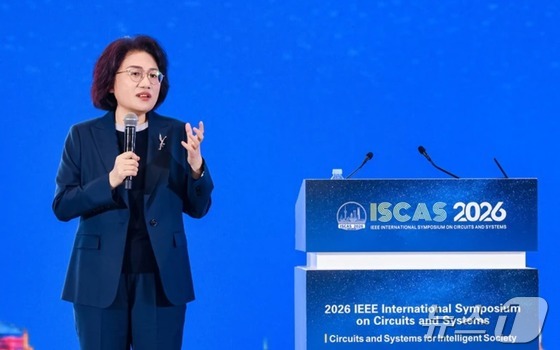
China’s Huawei has expressed confidence in accelerating semiconductor chip evolution through Tau’s Law, which focuses on reducing time rather than improving spatial integration as the key to semiconductor development.
He Tingbo, president of Huawei’s semiconductor division, emphasized in an interview with the People’s Daily on Thursday that Tau’s Law is a groundbreaking achievement in fundamental theoretical research, crucial not only for chips but for the entire semiconductor industry. The semiconductor industry will face challenges in the next 5 to 10 years, and we must seriously consider the path of Tau’s Law.
She had virtually no public appearances since the announcement of U.S. sanctions against Huawei in 2019. Recently, she drew attention by attending an event hosted by the Institute of Electrical and Electronics Engineers (IEEE) in Shanghai, where she delivered a speech on Exploring and Implementing New Paths for Semiconductors.
Tau’s Law, the first semiconductor-related principle proposed by China, aims to enhance performance by optimizing communication time between internal chip elements through technologies like logic folding. Tao (韬) is the Chinese pronunciation of tau (τ), which denotes the time constant in physics.
He stated that under Tau’s Law, chip evolution will progress rapidly, and announced that this fall, Huawei will unveil the first smartphone chip, Kirin, incorporating this new technology.
She added that they’re confident in the steady progress under Tau’s Law for the next 5 to 10 years. This pace can be compared to other methods and will continue to improve.
Tau’s Law is often contrasted with Moore’s Law, proposed by Intel co-founder Gordon Moore. Moore’s Law centers on improving performance by increasing transistor density within chips. Recently, experts have raised concerns about the challenges of continually increasing transistor density in nanometer-scale chips.
She pointed out that Moore’s Law will hit the wall of physical limitations within the next decade, explaining that Huawei encountered this wall earlier due to external constraints.
She described logic folding as the core technology of Tau’s Law, highlighting that over the past six years, it has independently developed 381 chips based on this principle.
She noted that it took a decade for Moore’s Law to gain full industry acceptance, adding that some may join the path in three days, others might take three to five years, but it welcomes everyone.
He expressed confidence that Tau’s Law is the key to overcoming sanctions against Huawei.
She reflected that since May 2020, the restrictions imposed on Huawei have been far more severe than anticipated, making it feel like we were thrust back into a primitive society overnight. Ultimately, it had to return to scientific fundamentals and reconsider the approach from first principles.
He claimed that seven years later, they have found a promising solution, stating that seven years ago, it was uncertain of the path, but Tau’s Law’ is one of the answers they’ve uncovered.