


North Korea has significantly revised its road traffic law, introducing bans on smoking and mobile phone use while driving, prohibiting jaywalking and establishing new regulations for electric bicycles, according to reports Thursday.
The changes are seen as part of broader “modernization” efforts reflecting rising traffic volumes driven by the expansion of private vehicle ownership and the growing use of electric bicycles.
North Korea’s state-run Korean Central Television aired a two-part program on May 24 titled “Law and Citizens,” outlining key revisions to the updated road traffic law.
Im Myong-hak, a researcher at the Faculty of Law at Kim Il Sung University, appeared on the program to explain the main amendments.
According to the broadcast, the revised road traffic law was adopted during a meeting of the Standing Committee of the Supreme People’s Assembly on Sept. 15, 2024.
North Korea’s road traffic law had previously been understood to consist of 103 articles across seven chapters, but the latest revision expands it to 124 articles in eight chapters.
The amendments substantially tighten regulations governing drivers.
The revised law bans smoking and mobile phone use while driving, prohibits drivers from sticking their hands out of vehicle windows and imposes restrictions on fatigued driving.
The definition of drunk driving has also been expanded to include driving under the influence of psychoactive substances, while lending vehicles to unlicensed individuals has been newly prohibited.
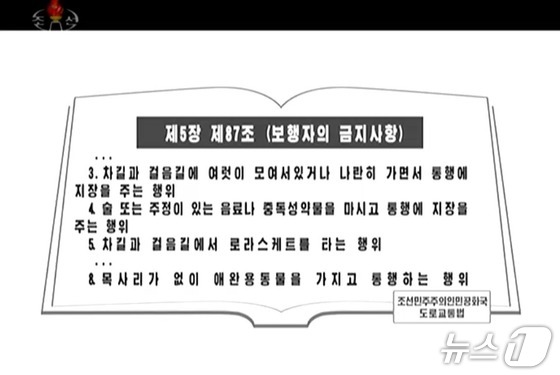
Rules governing pedestrian behavior have also been strengthened.
The revised law introduces a new category titled “prohibited acts by pedestrians,” banning jaywalking on roads equipped with crosswalks.
Pedestrians can also face penalties for obstructing foot traffic, including walking side by side on sidewalks or disrupting pedestrian flow while intoxicated.
Notably, the amendment introduces the concept of “tourist roads” for the first time.
In addition to highways, the law prohibits crossing tourist roads outside designated crossing areas, a move that appears tied to North Korea’s broader push to expand tourism zones nationwide, including the Wonsan-Kalma Coastal Tourist Area, which opened last year.
Electric bicycles are now formally classified as a separate mode of transportation for the first time.
The revised law lays out detailed standards governing e-bike speed limits, operating methods and headlight use, while also requiring riders to travel in single file on bicycle lanes.
It also mandates that riders dismount and walk their bicycles when crossing roads.
The amendment additionally bans modifications such as attaching automobile horns to electric bicycles, after authorities identified such practices among some users.
New provisions related to pets have also been added.
The revised law explicitly prohibits walking pets on public roads without a leash.
The measure appears to reflect the growing popularity of pet ownership, particularly in Pyongyang.
Analysts say North Korea’s decision to revise and heavily publicize the road traffic law likely reflects the rapid increase in privately owned vehicles and modern transportation methods such as electric bicycles.
Over the past two to three years, North Korea has reportedly allowed vehicles to be registered under private ownership, contributing to an influx of Chinese-made vehicles, particularly in major cities.
The revision is also being interpreted as part of Kim Jong-un’s broader push to institutionalize tighter control over daily life under his stated goal of building a “socialist law-based state.”