

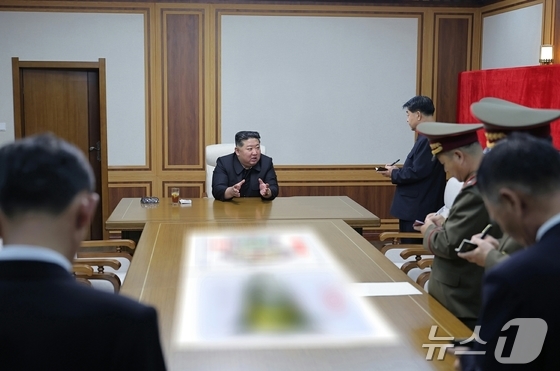
North Korea has made headlines with extensive coverage of Supreme Leader Kim Jong Un’s inspection of a newly operational nuclear material production facility, blatantly showcasing its commitment to bolstering its nuclear arsenal. Simultaneously, the regime highlighted the historical victory of the anti-Japanese armed struggle known as the Battle of Pochonbo, underscoring its policy of self-reliance and independence. The reports also emphasized internal cohesion by focusing on enhancing political awareness among party members and supporting students and overseas compatriots.
The Workers’ Party’s official newspaper, Rodong Sinmun, reported on its front page that Kim had inspected the new nuclear material production facility the previous day. Kim declared that the production capacity of weapons-grade nuclear materials has more than doubled, reaffirming the party’s directive to expand nuclear material production and increase the nuclear weapons stockpile, as decided at the 9th Party Congress. He specifically emphasized the need for both qualitative and quantitative enhancements of nuclear deterrence and claimed to have established an extensive plan to exponentially strengthen the country’s nuclear capabilities.
Page 2 featured a lengthy editorial commemorating the anniversary of the Battle of Pochonbo, promoting the spirit of the anti-Japanese armed struggle and the doctrine of self-reliance. The paper characterized the Battle of Pochonbo as a revolutionary flame ignited by the belief in independence and self-respect, asserting that today’s advancements in national development, defense capabilities, and regional development policies are also products of self-reliance and the spirit of independence.
The third page cited decisions from the 9th Party Congress, urging party members to enhance their political consciousness and engagement. The newspaper showcased members from the Sangwon Cement Union Enterprise as exemplary cases, emphasizing that party members should lead the public in implementing party policies.
Page 4 highlighted the Pyongyang Bag Factory’s selection as one of the Top 10 Outstanding Enterprises for 2025, sharing its experiences in strengthening quality control. The factory reportedly transformed quality control from a task assigned to a specific department into a responsibility for all employees, thereby enhancing product competitiveness.
The fifth page emphasized the regime’s commitment to future generations in anticipation of the 80th anniversary of the Korean Children’s Union. The report showcased schools nationwide, youth camp sites, and secondary academies, touting free distribution of student uniforms, bags, and school supplies, as well as school modernization projects as achievements of Kim’s policies prioritizing future generations. It particularly stressed that equal educational conditions are provided even to schools in remote mountainous areas.
The final page was dedicated to news related to the General Association of Korean Residents in Japan (Chongryon). It reported on the 70th anniversary of Chosun University, announcing the appointment of professors and associate professors as well as the awarding of honors, encouraging the cultivation of patriotic talent within the Korean community in Japan. Additionally, it highlighted the activities of the Shinjuku branch in Tokyo and the Seibu branch in Chiba Prefecture, emphasizing harmony and unity within the Chongryon organization.