

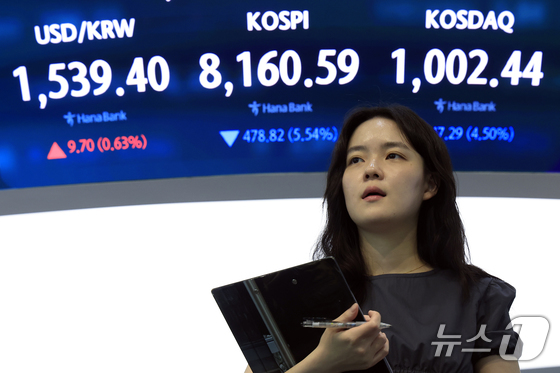
Major U.S. semiconductor stocks, including Nvidia, plummeted as the dollar-won exchange rate surpassed 1,560 KRW (about 1.02 USD). This confluence of domestic and international headwinds has put significant downward pressure on the Korean stock market.
Investors are bracing for a potential Black Monday, fearing the KOSPI might nosedive at Monday’s opening bell. However, some analysts view this as a buying opportunity, noting that the semiconductor sector’s robust profit growth outlook remains unchanged, despite the tumbling exchange rates and interest rates.
U.S. Semiconductor Index Plunges 10%; Focus Turns to Whether Samsung at 300,000 KRW and SK Hynix at 2 Million KRW Can Hold Support
Financial industry sources reported on June 7 that major U.S. stock indices, including the Dow Jones Industrial Average (-1.35%), S&P 500 (-2.64%), and Nasdaq Composite (-4.18%), all suffered sharp declines on June 5, wiping out over 1 trillion USD in market value in a single day.
Unexpectedly robust U.S. employment data for May crushed hopes for a Federal Reserve rate cut, severely dampening investor sentiment.
The Philadelphia Semiconductor Index, which tracks the top 30 semiconductor companies by market cap, plummeted 10.26% to 12,220.76, marking its steepest drop since the COVID-19 shock in March 2020.
Market leader Nvidia saw its stock slide 6.2%, while Marvell Technology nosedived 16.74%. Other industry giants also took hits, with Broadcom down 7.92%, AMD falling 10.86%, and Intel Corporation dropping 11.28%. Micron, considered one of the top three memory chip makers alongside Samsung Electronics and SK Hynix, also plunged 13.25%.
Global investment bank Raymond James predicted an earlier-than-expected peak in the semiconductor market, citing increased supply from Chinese firms and slowing demand from hardware companies. BNP Paribas and others echoed these concerns, further fueling the sell-off.
As Samsung Electronics and SK Hynix, Korea’s top two companies by market cap, have shown strong correlation with U.S. semiconductor stocks, their declining share prices are expected to exert downward pressure on the domestic market.
Samsung Electronics hit an all-time high of 365,000 KRW (about 238.80 USD) on June 2 but then fell 2.5% and 6.4% on consecutive days, closing at 329,000 KRW (about 214.80 USD) on June 5. SK Hynix has declined for three straight trading days since reaching 2,363,000 KRW (about 1,542.77 USD) on June 1. Notably, it plummeted 9.92% on June 5, closing at 2,007,000 KRW (about 1,310.34 USD), precariously close to the 2 million KRW (about 1,305.75 USD) threshold.
Foreign investors have been net sellers of Samsung Electronics for six consecutive trading days and SK Hynix for 20 straight days. Moreover, the KOSPI is heavily skewed towards semiconductors, with these two stocks significantly influencing the overall index. BNK Investment Securities reports that the semiconductor sector’s market cap share in the KOSPI 200 has more than doubled from 22.9% in May last year to 53.0% this year.
Exchange Rate Surges Past 1,560 KRW per USD; Solid Semiconductor Earnings Momentum Seen as a Buying Opportunity
The soaring USD-KRW exchange rate is also weighing heavily on the stock market. It reached a weekly high of 1,549.1 KRW (about 1.01 USD) during trading on June 5 and then surged to 1,561.5 KRW (about 1.02 USD) in after-hours trading. This marks the highest level in 17 years and three months, since March 10, 2009 (1,561.0 KRW or 1.02 USD), during the aftermath of the global financial crisis.
Lee Jin Kyung, an analyst at Shinhan Investment Corp, predicts the USD-KRW exchange rate will likely remain sticky in the low to mid-1,500s KRW (about 1.13-1.15 USD). While government intervention could temporarily strengthen the won, attempts to test the upper limit of the exchange rate are expected to continue until foreign investors complete their rebalancing and profit-taking.
Despite the market turbulence, analysts argue that the strong earnings outlook for the semiconductor sector, which has driven the KOSPI’s rise, remains intact. They suggest the current correction could present a buying opportunity.
According to financial data provider FnGuide, the consensus for Samsung Electronics and SK Hynix’s second-quarter operating profits stands at 85.8446 trillion KRW (about 56.1 billion USD) and 62.4215 trillion KRW (about 40.75 billion USD), respectively. Their projected annual operating profits for this year are a staggering 352.9141 trillion KRW (about 230.38 billion USD) and 257.6880 trillion KRW (about 168.22 billion USD). Industry experts expect the memory chip super cycle to continue until 2028.
Han Ji-young, an analyst at Kiwoom Securities, explains that the KOSPI’s sharp decline is driven more by technical and supply-demand factors, such as concerns over the rapid index increase and market concentration, rather than fundamental or macroeconomic issues. She notes that there’s room for further improvement in earnings momentum, and the recent plunge has created attractive valuations for the semiconductor-heavy KOSPI.
Kim Dae-jun, an analyst at Korea Investment & Securities, also views the June 5 stock price drop as market noise unrelated to memory market fundamentals or the earnings momentum of major players like Samsung Electronics and SK Hynix. He sees this as an opportunity to increase positions in these stocks.