

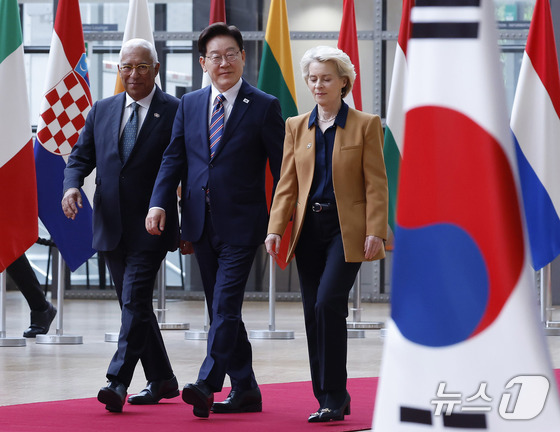
On Wednesday, President Lee Jae Myung held a summit with European Union (EU) leaders and issued a joint statement comprising 36 points.
The Korea-EU leaders strongly condemned North Korea for supporting Russia in its war against Ukraine and demanded an immediate cessation of North Korea’s nuclear and ballistic missile programs. They unequivocally stated that recognizing North Korea as a nuclear power is absolutely unacceptable and urged compliance with United Nations (UN) Security Council resolutions.
This represents the most forceful message from the Lee administration, which had previously taken a more conciliatory approach toward North Korea, raising questions about potential North Korean reactions.
The summit resulted in 36 agreements, including the establishment of a high-level economic dialogue between Korea and the EU, aimed at bolstering their strategic partnership.
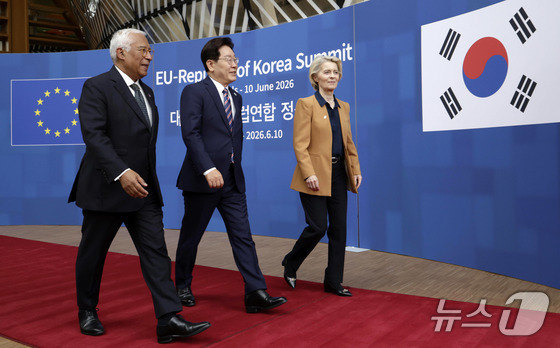
President Lee announced the joint statement during a summit in Brussels with António Costa, the EU Council President, and Ursula von der Leyen, the President of the European Commission.
The leaders affirmed that the strategic partnership continues to strengthen across all sectors, contributing to the prosperity and security of our citizens. It welcomes the progress since our last summit and commit to further developing the partnership in all aspects.
Key agreements include establishing a High-Level Economic Dialogue (HLED) (Item 4), signing a Korea-EU Digital Trade Agreement (Item 6), promoting a Korea-EU Competitiveness Partnership (Item 3), initiating negotiations for a Classified Information Protection Agreement (Item 8), signing an AI cooperation document (Item 19), launching high-level energy dialogues (Item 27), and swiftly implementing negotiations for a Passenger Name Record (PNR) transmission agreement to combat terrorism and serious crime (Item 34).
Nuclear-Armed North Korea Not Recognized; Lee Government Issues Strongest-Ever Condemnation of Illegal Russia–North Korea Military Cooperation
The joint statement notably escalated previous positions by explicitly criticizing Russian military support for North Korea, in addition to condemning Russia’s invasion of Ukraine.
While the level of criticism regarding North Korea’s nuclear and missile programs has moderated compared to the 2023 Korea-EU summit under the Yoon Suk Yeol administration, it still represents a robust condemnation given the Lee administration’s approach to Korean Peninsula issues.
The Korea-EU leaders condemned the invasion of Ukraine, emphasizing the need for a comprehensive ceasefire. They pledged support for Ukraine’s recovery and reconstruction, discussed expanding aid, and stressed the importance of effective and consistent sanctions implementation.
The leaders specifically denounced third-party support, particularly from North Korea, that enables Russia’s ongoing invasion of Ukraine, stating that it strongly condemns the illegal military cooperation between Russia and North Korea. They demanded both countries immediately cease all related activities and adhere to the UN Charter and relevant Security Council resolutions.
Expressing grave concern over North Korea’s nuclear and ballistic missile programs, they reaffirmed their commitment to complete denuclearization of the Korean Peninsula in line with UN Security Council resolutions. They insisted that North Korea must fully comply with its non-nuclear weapon state obligations under the Treaty on the Non-Proliferation of Nuclear Weapons (NPT) and implement the Comprehensive Safeguards Agreement with the International Atomic Energy Agency (IAEA).
Addressing North Korea’s recent nuclear power declaration, they asserted that North Korea must fully comply with its NPT obligations as a non-nuclear weapon state and implement the Additional Protocol. North Korea will never be recognized as a nuclear power under the NPT and will not hold any special status in this regard.
However, they reaffirmed their commitment to peace and stability on the Korean Peninsula, supporting South Korea’s efforts to resume inter-Korean dialogue through tension reduction and trust-building measures, aimed at expanding exchanges, normalizing relations, and achieving denuclearization.
The Korea-EU leaders also emphasized the necessity of substantial improvements in North Korea’s human rights situation and demanded access for international organizations and humanitarian agencies.
Calls for De-escalation in the Middle East and Freedom of Navigation; Stresses Importance of Peace and Stability in the Taiwan Strait, While Taking a General Position on Steel Restrictions
Regarding tensions in the Middle East and South China Sea, the Korea-EU leaders upheld their position on maintaining freedom of navigation and stability.
Discussing the Middle East situation and its global impact, they called for de-escalation and restraint, emphasizing freedom of navigation in the Strait of Hormuz, civilian protection, and adherence to international law, including the United Nations Convention on the Law of the Sea (UNCLOS).
They reaffirmed support for freedom of navigation in the South China Sea, stressed the importance of peace in the Taiwan Strait, and opposed unilateral attempts to alter the status quo in the Indo-Pacific region.
On EU steel industry regulations, the leaders issued a general statement committing to address global steel overproduction through forums like the Global Forum on Steel Excess Capacity (GFSEC).