

On Thursday, speculation arose that the fate of two North Korean prisoners of war captured in Ukraine depends on South Korea’s level of support and investment in Ukraine’s post-war reconstruction efforts.
While both countries publicly stated they are discussing the issue in accordance with international law and humanitarian principles, reports suggest that behind-the-scenes negotiations are focusing on how and to what extent South Korea can participate in Ukraine’s planned reconstruction projects. Analysts believe Ukraine is using the North Korean prisoner of wars (POWs) as diplomatic leverage to secure South Korea’s active involvement in the rebuilding process.
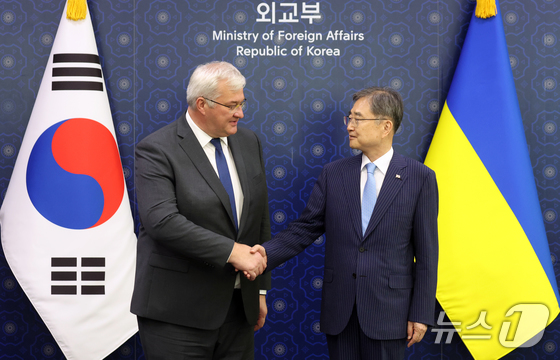
On Tuesday, South Korean Foreign Minister Cho Hyun and Ukrainian Foreign Minister Dmytro Kuleba held bilateral talks in Seoul. They announced their commitment to seeking a resolution to the North Korean POW issue that respects the free will of those involved and aligns with international law and humanitarian principles.
While specific details of their discussions regarding the POWs’ potential transfer to South Korea were not disclosed, observers noted that Kuleba’s visit – the first by a Ukrainian foreign minister to South Korea in 11 years – suggests significant progress in the negotiations between the two nations.
Ukraine Uses North Korean POWs as Bargaining Chip; Russia Also Reportedly Made a Big Offer to Increase Negotiating Power
Given Ukraine’s emphasis on international law and humanitarian principles, the likelihood of the North Korean POWs being forcibly repatriated to North Korea or Russia appears low. As both prisoners have expressed a desire to go to South Korea, their transfer now seems to hinge on bilateral negotiations between Seoul and Kyiv.
However, diplomatic sources suggest that while there may be a broad consensus on the POWs’ return to South Korea, predicting the timing of their repatriation remains challenging. Since Ukraine views South Korea’s participation in reconstruction efforts as a key bargaining chip, the POWs’ transfer could potentially be delayed until post-war rebuilding discussions gain momentum.
During his visit, Kuleba reportedly told the Asan Institute for Policy Studies that Russia had proposed exchanging 2,000 Ukrainian prisoners for the two North Korean POWs, adding that a compelling rationale would be needed to persuade the Ukrainian public to support sending the North Koreans to South Korea. However, diplomatic circles view this as a tactical move by Ukraine to enhance its negotiating position.
Many find it implausible that Russia would offer to exchange 2,000 Ukrainian prisoners for just two North Korean POWs.
A South Korean foreign ministry official told News1 that who would rationally exchange thousands for just two? Such discussions have never occurred between governments, and it doesn’t believe Russia would make such an offer. The official emphasized that the prisoner issue should not be approached transactionally, but rather from humanitarian and international law perspectives. This suggests that the South Korean government is responding to Ukraine’s demands by prioritizing humanitarian principles.
Another foreign ministry official stated that while directly linking the POWs’ transfer to South Korea’s support for Ukrainian reconstruction efforts is challenging that if the situation allows, it could invest, and Ukraine could invite the companies to participate in reconstruction projects. There are various scenarios to consider.
Ukraine anticipates participation from South Korean companies in various sectors, including infrastructure, energy, and advanced technology, during the post-war reconstruction process. The South Korean foreign ministry also indicated that it continues to review humanitarian support for Ukraine’s recovery and rebuilding efforts.
However, the South Korean government maintains that it should not approach the POW transfer and reconstruction support as a quid pro quo exchange. Consequently, Seoul is expected to seek an appropriate approach through further negotiations while continuing to explore options for supporting reconstruction and investment behind the scenes.