

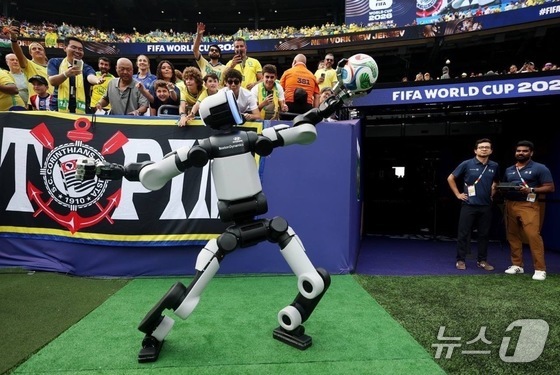
Boston Dynamics, a robotics subsidiary of Hyundai Motor Group, made waves at the 2026 International Federation of Association Football (FIFA) World Cup with its humanoid robot Atlas during the halftime show, capturing the attention of major international media outlets.
The global press lauded this event as a landmark demonstration of the progress in learning-based humanoid technology, its potential applications in manufacturing, and Hyundai’s forward-thinking robotics strategy.
According to Hyundai Motor Group, Atlas took center stage on July 5 at the New York-New Jersey Stadium during the World Cup Round of 16 halftime break. The robot recreated various goal celebrations of soccer players and handed the match ball to the referee. This captivating performance rivaled the game itself in grabbing worldwide fan attention, leading to extensive coverage by global media.
Fortune magazine hailed the scene as unprecedented in World Cup history. The publication praised the next-generation humanoid technology for its ability to learn independently and adapt to various environments, setting it apart from traditional pre-programmed industrial robots.
Quoting a Boston Dynamics representative, Fortune explained that while conventional industrial robots follow pre-set commands, Atlas learns human movements and adapts to new environments. This learning method was likened to that of large language models (LLMs).
The report also highlighted Atlas’s impressive learning capabilities. Using game footage of famous soccer players and motion capture data from engineers, Atlas could master complex movements in simulation environments. Skills that typically take athletes years to perfect, the robot could learn in about 24 hours.
Fortune underscored the significance of the World Cup stage as a real-world test for Atlas. Unlike controlled lab or factory settings, the unpredictable soccer field required a newly designed walking algorithm. This allowed Atlas to maintain stability while executing instinctive responses, akin to muscle memory in humans, developed through training rather than real-time calculations.
The article also revealed Hyundai Motor Group’s plans to mass-produce Atlas for automotive manufacturing processes at future U.S. robotics production facilities. Some manufacturing processes are already undergoing trial operations. A group spokesperson emphasized that Hyundai views robotics as a cornerstone of future competitiveness, with this World Cup serving as a pivotal moment to showcase their cutting-edge technologies to the general public.
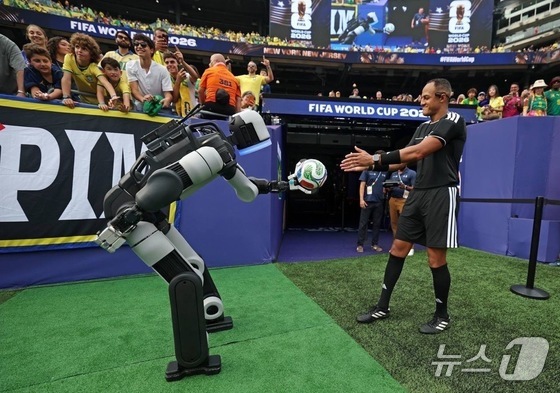
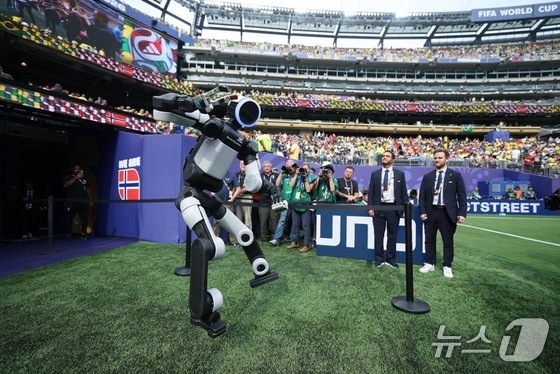
Bloomberg reported that Hyundai Motor Group’s public demonstration of Atlas at the World Cup highlighted the company’s progress in robotic technology poised for factory deployment. The news outlet noted the significance of this being the first public demonstration since unveiling the production model at the Consumer Electronics Show (CES) 2026 in January.
Hyundai aimed to prove that advanced robotics can transition from controlled laboratory environments to real-world applications, demonstrating the ability to perform complex tasks amid unpredictable conditions.
A Boston Dynamics spokesperson explained that Atlas is learning to adapt to various real-world variables, with potential applications across diverse industrial settings.
Reuters focused on the technical hurdles overcome to ensure Atlas’s stable performance at the World Cup venue. The large crowd rendered the existing Wi-Fi system unusable, necessitating a separate wireless communication setup. The report also detailed how Atlas employed a new learning method tailored to the soccer field’s unique characteristics for improved stability.
The article further revealed Hyundai Motor Group’s plans to mass-produce humanoid robots for automating high-risk and repetitive tasks, with a phased introduction of Atlas to U.S. production facilities starting in 2028.
ADWEEK, a leading U.S. marketing publication, praised Hyundai Motor Group for presenting an innovative global marketing strategy that seamlessly blends robotics technology with brand vision through the 2026 FIFA World Cup.
The magazine emphasized that this performance marked the first public demonstration of humanoid robots in a real-world setting and their debut integration into a World Cup event. A Hyundai representative explained that the company aimed to showcase its robotics prowess and future vision on a global stage, transcending the role of a mere World Cup sponsor.
The report also detailed the advanced technologies incorporated into Atlas, including retargeting technology for implementing human movements, reinforcement learning based on simulations, and whole-body control technology for integrated movement.