

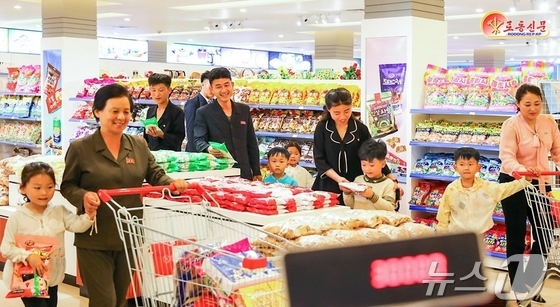
On Tuesday, an analysis emerged suggesting that North Korea is dismantling local markets and constructing multifunctional Comprehensive Service Centers to create new markets under its Local Development 20×10 Policy.
This move is interpreted as an attempt to replace the informal markets, where the regime’s control is not absolute, with state-managed markets, thereby tightening the authorities’ grip on free markets.
U.S.-based North Korea-focused media outlet NK News, analyzing satellite imagery from private companies Planet Labs and Maxar, confirmed that markets in Gangdong and Gaepung counties, where Comprehensive Service Centers were first established last year, have been demolished. Parts of the market in Jeongpyeong County have also been dismantled.
The new markets are being developed within the Comprehensive Service Centers, which North Korea is building nationwide as part of Kim Jong Un’s flagship Local Development 20×10 Policy. These centers are modern multifunctional facilities aimed at bridging the living standard gap between Pyongyang and the provinces.
North Korea’s Local Development 20×10 Policy has been in progress since 2024. The initial plan was to construct modern local factories in 20 cities and counties over a decade, but the policy objectives have since expanded to include building regional hospitals and Comprehensive Service Centers.
NK News reported that in the 21 cities and counties where construction is currently underway as part of the Local Development 20×10 Project, existing markets appear to still be operational. The markets in Gangdong, Gaepung, and Jeongpyeong were reportedly demolished in April this year, about four months after the Comprehensive Service Centers opened last December.
These markets, which emerged organically across the country during the Arduous March period of the mid-1990s, have become crucial for sustaining North Korea’s economy and citizens’ livelihoods. Initially, North Korean authorities targeted these markets for strict regulation, but after failing to contain their spread, they implemented various policies to integrate them into the formal economy.
NK News noted that since the authorities’ intervention, the markets have operated under a system where individuals pay rent to sell goods they have procured, with the authorities only controlling prices.

Peter Ward, a research fellow at the Sejong Institute’s Korea Strategy Center, told NK News that moving markets inside the Comprehensive Service Centers is part of an effort to strengthen state control. He explained that these markets have become a third space where residents form trust relationships and information networks outside state organizations, which poses a potential threat to Kim’s regime.
Ward further assessed that Kim’s Local Development 20×10 Policy is an attempt to revert the market-centered economy, which residents have relied on since the collapse of the rationing system in the 1990s, back under state control.
However, considering public sentiment, it remains unclear whether the new markets will be entirely state-controlled or if they will incorporate some operational methods from existing markets to accommodate established traders. Some experts believe that a transitional period may be necessary.