

U.S. tech giants are at odds over China’s open artificial intelligence (AI) models. Industry leaders OpenAI and Anthropic claim Chinese firms are replicating their AI models through distillation techniques, advocating for regulatory action. Meanwhile, NVIDIA and Microsoft argue that Chinese AI drives market innovation and competition, opposing such regulations.
This rift in Silicon Valley reflects complex factors, including apprehension about China’s rapidly advancing AI capabilities and divergent corporate interests based on individual business models.
The New York Times reported on July 25 that the Silicon Valley divide over regulating Chinese open-source AI models has reached a critical point.
Two main factions have emerged: closed AI model service providers led by OpenAI and Anthropic, and companies offering computing resources and open-source services, such as NVIDIA, Microsoft, and Google.
OpenAI and Anthropic initiated the regulatory push. They expressed concern after Chinese AI startup Moonshot AI unveiled its open-weight AI model, Kimi K3, alleging that Chinese companies are mimicking U.S. AI models through distillation. Kimi K3 reportedly matches the performance of OpenAI’s GPT 5.6 and Anthropic’s Claude 2, narrowing the AI technology gap with the U.S. to just 2-3 months.
The New York Times reports that both companies have recently engaged in behind-the-scenes lobbying of U.S. regulatory authorities regarding Chinese open-source AI models. In response, the Biden administration is reportedly considering sanctions related to intellectual property infringement concerning China’s open AI models.
This trend was also evident during the San Francisco AI Summit chaired by President Lee Jae Myung on July 24. Dario Amodei, Chief Executive Officer (CEO) of Anthropic, who attended the event, emphasized the need for AI collaboration centered around democratic nations and highlighted the role of U.S. allies.
He stated that democratic nations must lead and unite to fully harness AI’s potential, adding that it needs to drive AI development based on the shared values and prevent adversaries from gaining an overwhelming advantage in AI.
This statement appears to target China’s recent indications of its intent to establish a global AI governance system centered on its interests and to create relevant cooperative frameworks.
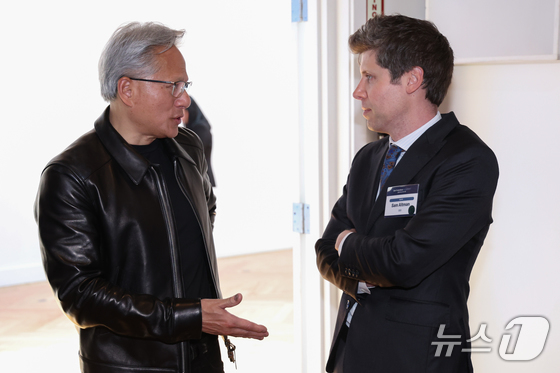
Conversely, on July 24, 25 major U.S. tech companies, including NVIDIA and Microsoft, sent an open letter to the Donald Trump administration urging careful consideration of open model regulations. Signatories included not only NVIDIA and Microsoft but also Meta, Google, Palantir, IBM, and other tech giants, as well as Hugging Face, the world’s largest AI platform, and global venture capital firm Andreessen Horowitz (a16z).
They asserted that open models expand accessibility to the AI economy and promote competition in innovation and security, emphasizing the need to maintain an open AI ecosystem.
Notably, Jensen Huang, CEO of NVIDIA, shared the full text of the open letter on his X (formerly Twitter) account, stating that open models enhance safety and cybersecurity, accelerate innovation and dissemination, and enable AI sovereignty. The world needs both advanced closed models and advanced open models.
The following day, on July 25, Sundar Pichai, CEO of Google, remarked that it has benefited from open-source for a long time and have significantly contributed to it, confirming that Google also signed the open letter.
This divergence in positions reflects the business models and interests of each company. OpenAI and Anthropic have invested heavily in developing closed AI models, meaning that the rise of China’s open AI models could undermine their revenue models. They are currently working to enhance the token efficiency of their AI models and are considering a pay-as-you-go pricing structure.
In contrast, companies like Microsoft and NVIDIA provide cloud services and graphic processing unit (GPU) based AI infrastructure, benefiting from the increased utilization of open models that drive demand for their platforms and infrastructure.
The Wall Street Journal commented on the conflict among Silicon Valley companies, stating that the process of countering China has intensified internal conflicts of interest within the U.S. industry. The New York Times noted that this dispute extends from the long-standing debate over open-source versus closed-source software that has persisted since the early days of the Silicon Valley tech industry.