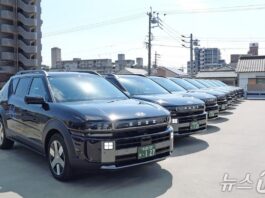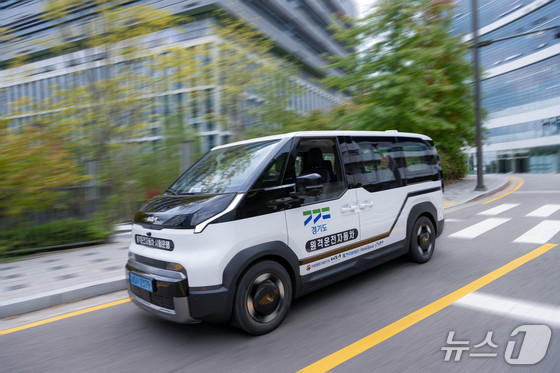
Kia said on the 16th that it had launched South Korea’s first pilot car-sharing service using remote-driving technology in the Pangyo area of Bundang-gu, Seongnam, Gyeonggi Province.
The pilot will run for about three months through the end of the year for employees of companies based in the Second Pangyo Techno Valley. The business-to-business (B2B) service will use Kia’s PV5 Passenger, a midsize purpose-built vehicle (PBV).
When users reserve a vehicle through a dedicated app, it travels to their requested location using remote-driving technology, without an onboard driver. Users take over the vehicle and drive it themselves, then park and return it at their preferred location. A remote-driving operator subsequently moves the vehicle back to its depot.
The service allows users to access vehicles wherever they need them without visiting designated pickup or return locations, improving convenience. Companies are expected to reduce the burden of owning and managing work vehicles while improving fleet efficiency and space utilization. To ensure safe operations, the service is equipped with triple communication networks to prepare for emergencies such as connection failures, as well as an emergency response system.
Kia is participating in the pilot consortium alongside SUM, MobiOps and the Korea Road Traffic Authority. Kia is providing the vehicles and overseeing the project, SUM is developing the remote-driving solution, MobiOps is managing service operations, and the Korea Road Traffic Authority is assisting with regulatory reviews.
During the pilot, the consortium plans to evaluate the technology’s reliability and the operational feasibility of the service under real-world conditions. Using data collected during the trial, it will continue improving the technology and aims to expand the service in 2027, accelerating plans to commercialize remote-driving services based on the PV5.
Remote driving is a technology that allows vehicles without onboard drivers to be operated and controlled remotely from an external control center using 4G and 5G wireless networks. Because it can use existing communication networks and conventional vehicles, it can significantly reduce costs compared with fully autonomous driving. When integrated with various mobility services, it could also help address transportation gaps in underserved areas.
Kia has previously advanced the technology and assessed its operational feasibility through various pilot projects and collaborations involving remote driving. In April last year, it received a regulatory sandbox exemption from the Ministry of Land, Infrastructure and Transport to conduct remote-driving demonstrations. In November of the same year, it formed a remote-driving consortium with Socar, KT and autonomous-driving startup SUM to conduct trials in locations including Jeju and Hwaseong.
In Jeju, Kia became the first automaker in South Korea to successfully demonstrate remote driving on public roads, completing a technical validation. Over the course of a month, the consortium conducted about 70 hours of driving tests covering 1,000 kilometers using vehicles including the PV5 on several public roads in Jeju, including routes between Jeju International Airport and the Jeju Socar Terminal, and between the airport and Yongduam Rock.
In July this year, Kia signed a memorandum of understanding with KT and SUM to commercialize remote-driving technology, and the companies have been working together toward a service launch by the end of the year. The Pangyo remote-driving car-sharing pilot is a result of that agreement and marks South Korea’s first case of testing the commercial viability of remote-driving technology in an actual service environment.