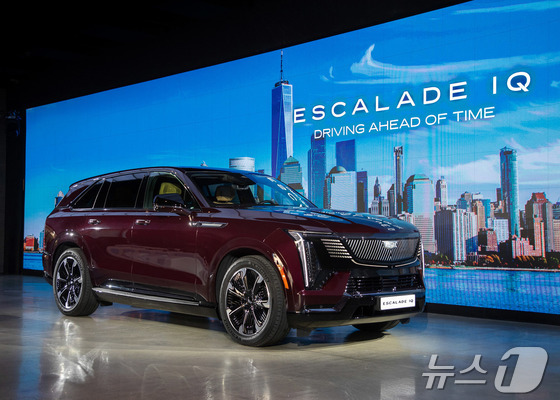
General Motors plans to introduce highway autonomous driving capabilities in the Cadillac Escalade IQ starting in 2028. The automaker aims to expand this technology to its major sport utility vehicles (SUVs) and pickup trucks, leveraging artificial intelligence (AI) and next-generation computing to bolster its autonomous driving competitiveness.
On Wednesday, GM unveiled its roadmap for expanding autonomous driving across key vehicle models and introduced its next-generation electric and computing architecture at the GM Forward event in New York City.
GM is currently testing highway autonomous driving features on pre-production vehicles in closed courses. Following the initial launch in the Cadillac Escalade IQ in 2028, the company plans to roll out this technology to its major internal combustion engine models.
The next-gen architecture features a separation of hardware and software, establishing a unified computing, networking, and software system applicable to both ICE and electric vehicles.
At the heart of this system is GM’s proprietary liquid-cooled central computing unit (CCU). This powerhouse delivers about 40 times the computing performance of current vehicles, integrating autonomous driving, active safety, chassis, and propulsion software into a single high-speed system. This integration enables simultaneous operation of AI functions and the autonomous driving system.
The zonal aggregator, connected via high-speed Ethernet, links sensors and actuators, supporting 36 times more data processing than previous systems. This setup cuts wiring length and weight by 30% while boosting cellular connection speeds by up to 50%.
This architecture also facilitates vehicle performance enhancements through over-the-air (OTA) updates, allowing improvements validated in one model to be applied across the fleet. GM plans to extend this next-gen architecture to its major ICE full-size SUVs and trucks, three-row crossovers, and fourth-generation electric vehicles (EVs).
For autonomous driving development, GM leverages real-world driving data and AI training. Users of GM’s Super Cruise driver assistance system have logged over 1.2 billion miles (approximately 1.93 billion km) of hands-free driving.
GM collects roughly 1 million miles (about 1.6 million km) of multi-sensor data monthly from consenting customer vehicles and hundreds of dedicated test vehicles.
This data collection combines imitation learning, reinforcement learning, and large-scale simulations. The company virtually drives over 3 billion miles (about 4.8 billion km) daily to learn from rare or challenging scenarios, evaluating various driving behaviors before real-world testing.
Through this learning and real-world validation, GM aims to enhance the safety and responsiveness of its autonomous driving systems, with plans to expand the technology to its high-volume trucks and SUVs.
In related news, GM Korea reported sales of 41,101 vehicles last month, a 73.3% increase year-over-year. The automaker’s cumulative sales in Korea this year reached 381,785 units, up 17% compared to the same period last year.