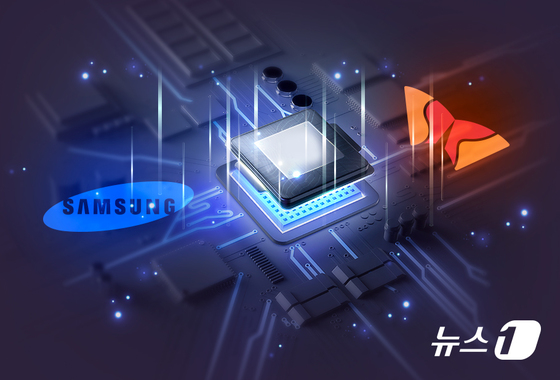
Samsung Electronics and SK Hynix, South Korea’s semiconductor powerhouses, both achieved record-breaking performances last year, demonstrating the resilience of the Korean chip industry. With the AI boom in full swing, analysts unanimously predict that both companies will surpass about $75 billion in operating profits this year. The most optimistic forecasts from securities firms project Samsung Electronics reaching about $135 billion and SK Hynix hitting approximately $111 billion in operating profits.
The biggest wild card, however, is the potential semiconductor tariffs hinted at by President Donald Trump. Currently, demand for memory chips far outstrips supply, with companies scrambling to secure inventory. If tariffs were imposed, it’s likely that U.S. firms, not Samsung or SK Hynix, would bear the brunt of the costs. This explains why Trump has yet to follow through on his threats.
Fierce competition from U.S.-based Micron and China’s CXMT also poses risks. Despite the recent passage of a special semiconductor support bill in South Korea’s National Assembly, calls for additional measures are gaining traction.
On Sunday, industry reports showed that Samsung Electronics’ consolidated revenue reached approximately $250.2 billion last year, with operating profits of $32.7 billion, up 10.88% and 33.23% year over year, respectively. Fourth-quarter revenue hit 93.84 trillion $70.4 billion, with a record-breaking quarterly operating profit of $15.6 billion. Samsung’s semiconductor division, Device Solutions (DS), was the star performer, generating fourth-quarter revenue of $33 billion and operating profit of $12.3 billion.
SK Hynix also maintained its upward trajectory. For 2025, the company reported annual revenue of $72.9 billion and operating profit of $35.4 billion. In the fourth quarter alone, it posted revenue of $24.6 billion and operating profit of $14.4 billion.
This stellar performance of Korean semiconductors is largely attributed to the industry’s supercycle, fueled by the AI revolution. The global rush to expand AI infrastructure, including data centers, has created unprecedented demand for high-bandwidth memory (HBM), server DRAM, and enterprise SSDs. Currently, only Samsung Electronics, SK Hynix, and Micron can realistically meet this surging demand. Consequently, both Korean giants are expected to not only exceed $75 billion in annual operating profits but potentially approach $112.5 billion this year.
The mood within Samsung reflects this optimism. The company projects its HBM sales will triple year over year, underscoring its commitment to expanding its market share. Samsung has also officially announced plans to begin mass production of HBM4 in February.
SK Hynix, a leading player in the HBM market, has reportedly secured about two-thirds of Nvidia’s HBM4 orders. The company plans to transform its U.S. NAND flash subsidiary, Solidigm, into an AI investment and solutions hub, and to establish a new subsidiary to manage its enterprise SSD and high-capacity NAND businesses.
Despite the positive outlook, significant challenges remain. The U.S. government’s consideration of unprecedentedly high tariffs on semiconductor products poses the greatest threat. While South Korea has been promised most-favored-nation treatment, better than that offered to Taiwan, the situation remains volatile. Trump has already backtracked on previous negotiations, threatening to raise tariffs on various products, including automobiles, from 15% to 25%.
The impact of tariffs was starkly illustrated in Hyundai Motor Group’s recent results. Despite posting record revenue of about $225.3 billion last year, the company faced an annual operating loss of about $5.4 billion due to U.S. tariffs. This resulted in a 23.6% year-over-year decrease in operating profit to $15.4 billion.
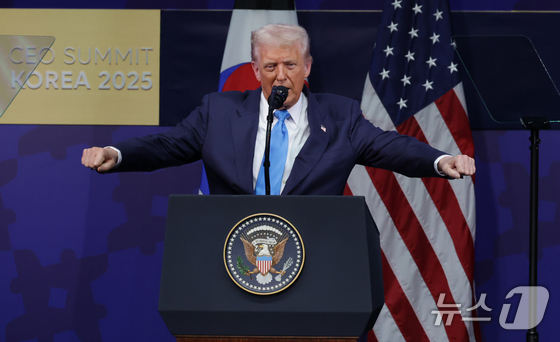
Trump’s threats essentially boil down to pressuring semiconductor companies to build factories and produce in the U.S. Samsung Electronics has already planned investments totaling about $367.5 billion, while SK Hynix has earmarked $468 billion. With both companies stretching their investment capabilities to the limit, accommodating U.S. demands will be challenging.
Global competitors are also ramping up their efforts to challenge Samsung and SK Hynix’s dominance. U.S.-based Micron is aggressively expanding its production capacity, investing $100 billion in a new mega fab in Onondaga County, New York. Set to be the largest semiconductor manufacturing complex in the U.S., the facility plans to house up to four fabs and begin operations by 2030.
Micron is also investing $15 billion in its Idaho headquarters to build R&D facilities and enable cutting-edge DRAM production. Additionally, it recently acquired PSMC’s Tongluo P5 fab in Taiwan for about $1.8 billion.
China’s CXMT is rapidly advancing its technological capabilities. With a 5% global DRAM market share, ranking fourth, its growth trajectory is concerning for competitors. Founded in 2016, CXMT successfully began mass-producing 10-nanometer DRAM in 2023, becoming the first in China and fourth globally to achieve this milestone. The company has received substantial support, with local Chinese governments investing $1.95 billion and strong backing from the central government.
While experts generally agree that CXMT’s technological capabilities are not yet on par with those of Samsung Electronics and SK Hynix, historical precedents in advanced industrial development suggest it could become a significant threat in the future.
In response to these challenges, South Korea has taken steps to support its semiconductor industry. On Thursday, the National Assembly passed a special law to bolster competitiveness and foster innovation in the semiconductor sector by providing financial and administrative support. While the industry’s request for an exemption from the 52-hour workweek regulation for R&D personnel was not included, the ruling party has proposed starting discussions in February to potentially relax this regulation for semiconductor researchers.