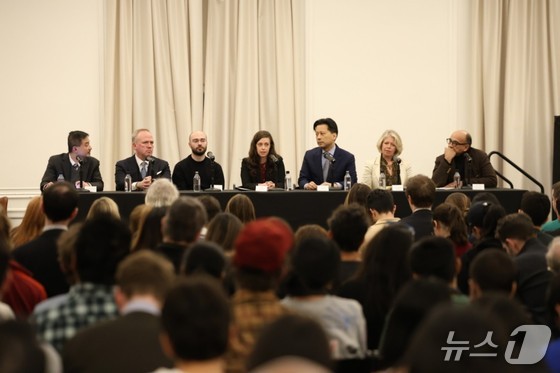
Korea Advanced Institute of Science and Technology (KAIST) and New York University (NYU) jointly hosted the KAIST-NYU Artificial Intelligence (AI) and Digital Governance Summit in New York City, as announced on Monday.
The summit was designed to explore practical AI governance solutions that balance technological innovation with safety and ethical responsibility, given the rapidly expanding influence of AI across society. The event featured a combination of closed-door consensus meetings and public discussions.
The summit brought together 60 global AI governance leaders from academia, industry, and civil society. Notable participants included NYU professors Matthew Liao and David Chalmers, Vicki Nash, director of the Oxford Internet Institute, Vincent Conitzer from Carnegie Mellon University, Iason Gabriel, a senior scientist at Google DeepMind, and Philip Goldberg, former U.S. Ambassador to South Korea. The public discussion on the second day drew over 450 attendees, highlighting the high level of interest in the topic.
This event was notable for its experimental consensus model, aimed at developing actionable AI governance frameworks rather than serving as a typical forum. KAIST’s Center for Science and Technology and Global Development (G-CODEs) and NYU’s Center for Bioethics had been collaborating since December of the previous year, forming three working groups focused on essential governance requirements, institutional architecture, and implementation pathways.
At the New York venue, intensive discussions and voting in a consensus meeting format led to the development of action-oriented recommendations. The Essential Governance Requirements group discussed the need for enhanced oversight and monitoring of high-risk AI systems. The Institutional Architecture group examined design principles for AI oversight bodies, drawing inspiration from existing high-risk technology oversight models such as the FDA, IRB, and FAA. The Implementation Pathways group addressed short-term governance measures and corporate responsibility standards that could be applied even during gaps in international regulations.
The summit also included experts from major global tech companies such as Meta, Google DeepMind, IBM, Amazon, Anthropic, TikTok, and Hugging Face. KAIST representatives, including Kim So-young, Director of International Cooperation, Park Kyung-ryul, professor at the Graduate School of Science and Technology Policy and G-CODEs Center Director, and Kim Hyung-jun, head of the AI College’s Future Studies Department, shared Korea’s achievements in AI governance research. The event was supported by the Korea Foundation (KF) through its international joint research program.
Professor Park Kyung-ryul of KAIST stated that this summit was a significant effort to broaden the scope of AI governance beyond technical regulation to encompass international cooperation and institutional design. Through its collaboration with NYU, it aims to establish a foundation for Korea to lead global discussions on AI governance.
KAIST President Lee Kwang-hyung emphasized that the importance of governance discussions is growing for responsible AI innovation, adding that KAIST will spearhead interdisciplinary research and policy discussions in AI governance through international partnerships.