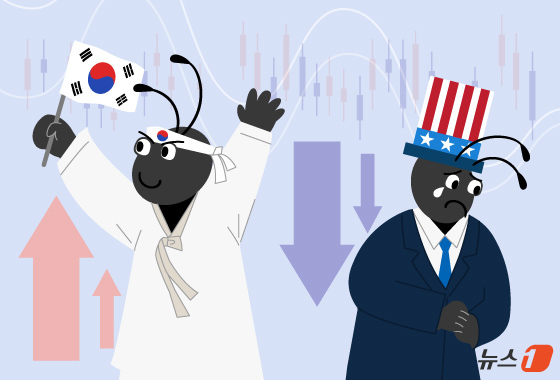
Throughout February, the KOSPI index experienced a historic rally, signaling a boom in South Korea’s stock market. Meanwhile, U.S. markets struggled, leading to significant losses for American investors in Korean stocks. This situation has sparked a wave of self-deprecating humor, with some quipping that fleeing the U.S. market is a sign of intelligence, as investment funds continue to exit.
The Korea Exchange reported that the KOSPI index, which stood at 4,949.67 on Monday, closed at 6,244.13 on February 27, marking a remarkable 26.2% increase over the month. Samsung Electronics, a key driver of the KOSPI rally, surged by 43.9%, while SK Hynix rose by 27.8%, spearheading the market’s upward trajectory.
In stark contrast, U.S. stock markets saw significant declines. During the same period, the Nasdaq index fell from 23,592.11 to 22,668.21, a 3.9% decrease in February. The S&P 500 index also dipped from 6,976.44 to 6,878.88, down 1.4%, underperforming compared to the KOSPI.
Among the top 50 stocks favored by Korean investors in U.S. markets, 35 saw their prices decline. Many individual stocks popular with American investors also took a hit. An analysis by News1 of overseas stock custody data from the Korea Securities Depository revealed that only 15 out of the top 50 foreign stocks (based on custody amounts as of February 26) saw price increases during the month. This translates to losses for 7 out of every 10 stocks.
Notably, none of the top 10 stocks held by investors saw price increases in February. The declines included: Tesla (-4.6%), NVIDIA (-4.5%), Alphabet Class A (-9.3%), Palantir (-7.2%), Apple (-2.2%), Invesco QQQ ETF (-3.0%), Vanguard S&P 500 ETF (-1.4%), IonQ (-0.5%), Microsoft (-7.2%), and ProShares UltraPro QQQ ETF (-10.1%).
Some stocks experienced dramatic drops. Seven stocks fell by more than 10% in February, ranked by custody amount: ProShares UltraPro QQQ ETF (-10.1%), Direxion Daily Tesla Bull 2X Shares (-10.5%), Amazon (-13.6%), Irene (-22.9%), AMD (-18.7%), Bitmine (-14.3%), and NuScale Power (-22.0%).
The 15 stocks that did increase in value (ranked by custody amount) were: Schwab U.S. Dividend Equity ETF (+5.9%), iShares U.S. Short-Term Treasury Bond ETF (+0.27%), TSMC (+9.7%), iShares Silver ETF (+17.3%), JPMorgan Equity Premium Income ETF (+2.5%), SPDR Gold Shares ETF (+13.3%), Realty Income (+10.7%), UnitedHealth (+2.7%), iShares U.S. 20+ Year Treasury Bond ETF (TLT; +4.9%), Circle Internet Group (+41.8%), Berkshire Hathaway Class B (+3.6%), U.S. 20+ Year Treasury Bond Yield 3X ETF (TMF; +14.2%), ASML (+0.6%), Netflix (+16.3%), and Lumen Technologies (+65.6%).
The phrase, Fleeing the U.S. market is a sign of intelligence, reflects the current sentiment as funds continue to exit due to the recent underperformance of U.S. stocks. Concerns about capital investment costs and artificial intelligence (AI) have weighed heavily on major tech stocks. Additionally, uncertainties regarding tariffs following a U.S. Supreme Court ruling and geopolitical tensions, including U.S.-Iran relations, have limited stock price increases. The KODEX U.S. Stock ETF, which tracks the net buying trend of Korean individual investors in U.S. stocks, reported a return of -4.5% in February.
As the U.S. stock market struggles, the sentiment that fleeing the U.S. market is a sign of intelligence has gained traction, leading to a trend of capital outflow. According to the Korea Securities Depository, as of February 27, the custody amount for U.S. stocks stood at 166.5 billion USD, a 0.9% decrease from the previous month’s 168 billion USD, marking the first monthly decline in three months since November last year.
Choi Bo-won, an analyst at Korea Investment & Securities, stated that the U.S. S&P 500 index still has potential for performance improvement, and the entry barrier has eased. It expects to see policy momentum reflected in the third quarter, so there remains potential for annual growth. However, he cautioned that in the short term, funds are likely to flow into European and Asian markets where policy momentum is more significantly reflected, which may limit growth in U.S. indices.