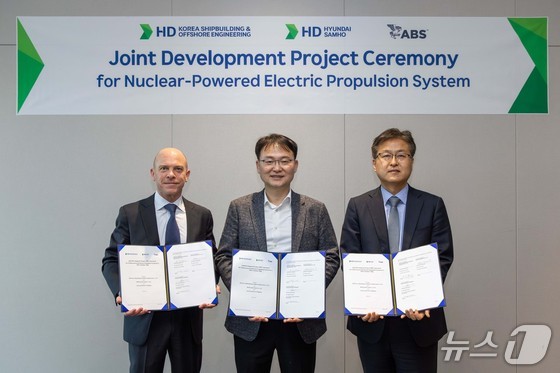
HD Hyundai announced on Monday that it has entered into a joint development agreement with the American Bureau of Shipping (ABS) for the conceptual design of a nuclear-integrated electric propulsion system, marking a significant step towards securing next-generation zero-carbon ship technology.
The agreement was signed at HD Hyundai’s Global Research and Development (R&D) Center, with key figures in attendance including Kwon Byeong-hoon, head of HD Korea Shipbuilding & Marine Engineering’s Electrification Center, Shim Hak-moo, head of design at HD Hyundai Samho, and Matthew Muller, ABS’s sales representative for East Asia.
The collaboration will focus on developing the basic design for a nuclear-integrated electric propulsion system, selecting specifications for electrical equipment, and designing the layout of power devices for 16,000 twenty-foot equivalent Unit (TEU) container ships.
A key aspect of the project is to explore the potential of small modular reactors (SMRs) as a new power source for ships, leveraging their ability to consistently supply up to 100 MW of power.
HD Hyundai plans to create a tailored power management system for large container ships that require extended voyages and high-speed operations. They also aim to boost propulsion and maneuverability by implementing a twin-propeller system, which offers superior agility and stability compared to single-shaft designs.
The company intends to adopt a direct-drive approach, connecting the engine motor directly to the propeller. This method will minimize energy loss during power transmission and increase operational efficiency. It will also allow for a higher capacity of refrigerated containers, enabling more flexible responses to shippers’ transportation needs.
Safety in nuclear power generation is a top priority for the project. The design will incorporate enhanced safety standards to ensure resilience in emergency situations such as collisions or flooding. The onboard power systems will be developed to comply with International Maritime Organization (IMO) regulations and International Atomic Energy Agency (IAEA) safety standards, ensuring both regulatory compliance and operational reliability.
Matthew Muller emphasized the significance of this collaboration, stating that this project is crucial for validating the feasibility of nuclear-based electric propulsion systems in large container ships. By combining HD Hyundai’s exceptional shipbuilding expertise with ABS’s proficiency in maritime safety engineering, it will thoroughly assess the safety, efficiency, and environmental impact of these next-generation propulsion solutions.
Shim Hak-moo commented that nuclear-integrated electric propulsion vessels represent a revolutionary advancement in achieving net-zero emissions. This technology could become a game-changer for HD Hyundai in the intensely competitive eco-friendly ship market.
HD Hyundai previously unveiled its nuclear-powered container ship model at the Houston Marine Nuclear Summit in February last year. In September, the company received Approval in Principle (AIP) from ABS for the conceptual design of an electric propulsion system for 16,000 TEU container ships at the Gastech 2026 event, further solidifying its position in this innovative field.