

As uncertainties escalate due to the U.S.-Iran conflict and the Strait of Hormuz blockade, the shipping industry’s first-quarter performance is under intense scrutiny. Despite facing challenges like route closures, surging freight rates suggest results may outperform initial projections.
However, post-Q1 performance could be significantly impacted by rising oil prices, creating a mixed outlook depending on companies’ ability to pass these costs onto freight rates.
HMM and Pan Ocean expected to beat consensus estimates
Financial data provider FnGuide reported on Wednesday that Pan Ocean is forecast to achieve a Q1 operating profit of 130.4 billion KRW (about 88.5 million USD), up 6.1% year-over-year.
HMM has a consensus operating profit estimate of 268.9 billion KRW (about 182 million USD), down 56.2% from last year. Analysts attribute this decline to a high base effect from the exceptional container shipping boom during the 2024 Red Sea crisis.
Recent analyses suggest both companies may surpass these consensus figures. NH Investment & Securities projects Pan Ocean’s Q1 operating profit at 138.5 billion KRW (about 94 million USD), about 6% above market consensus.
Shinhan Investment, Mirae Asset Securities, iM Securities, and Daol Investment & Securities also forecast above the 130.4 billion KRW (about 88.5 million USD) consensus. Of six brokerages reporting in April, only KB Securities predicted below consensus at 109.7 billion KRW (82.3 million USD).
For HMM, KB Securities anticipates a Q1 operating profit of 311.4 billion KRW (about 211 million USD), 15.8% above consensus. NH Investment & Securities and Daol Investment & Securities project 280.3 billion KRW (about 190 million USD) and 310.7 billion KRW (about 210 million USD) respectively, both exceeding market averages. Korea Investment & Securities aligns with the consensus at 268.0 billion KRW (about 182 million USD).
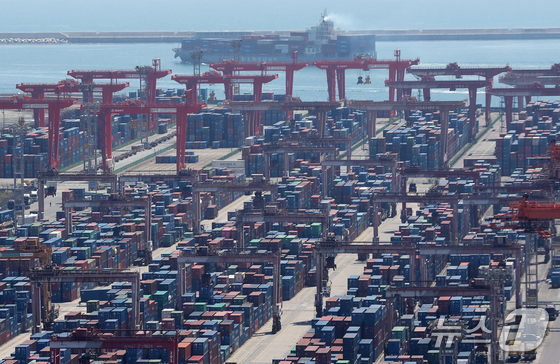
Container Rates Jump 42%, LNG Rates Soar 183%
The upward revisions stem largely from surging freight rates. The Shanghai Container Freight Index (SCFI), a global benchmark, skyrocketed 41.8% from 1,333.11 on February 27, when the conflict began, to 1,890.77 on April 10.
Middle East rates saw the steepest climb at 214%, but most regions experienced increases. This surge reflects a perfect storm of war-risk insurance hikes and escalating oil prices.
Energy supply chain disruptions have also driven up rates for various fuel carriers, including liquefied natural gas (LNG) tankers. NH Investment & Securities reports that short-term rates for 174,000 CBM LNG carriers soared 183.6%, from 30,500 USD per day on February 23 to 86,500 USD on April 13.
The weakening won could provide an additional boost. The dollar-won exchange rate climbed from 1,447.0 KRW (about 0.98 USD) at year-end to 1,510.5 KRW (about 1.03 USD) by late March, a 63.5 KRW (about 0.043 USD) increase. With most global shipping contracts dollar-denominated, a weaker won typically enhances earnings for Korean shippers.
Daol Investment & Securities analyst Oh Jeong-ha noted that Middle East logistical disruptions have temporarily boosted container freight indices. While rising oil prices are increasing costs, their impact on Q1 results should be limited.
Performance beyond Q1 will hinge on companies’ ability to pass on higher fuel costs. KB Securities has significantly raised its average fuel price forecasts for HMM and Pan Ocean by 68% and 44% respectively. Consequently, they’ve trimmed full-year operating profit projections by 2.8% and 10.4%.
However, iM Securities analyst Bae Se-ho offers a more optimistic view for Pan Ocean: Barring major oil price volatility, current freight rates already factor in higher fuel costs, minimizing concerns for Q2 results. It anticipates stable operating profits throughout the year.
NH Investment & Securities’ Jeong Yeon-seung commented on HMM: While shippers are cautious amid the short-term rate surge, growing concerns over potential operational disruptions due to fuel supply issues are strengthening major carriers’ negotiating power. This should positively impact Q2 results through improved fuel cost pass-through.