

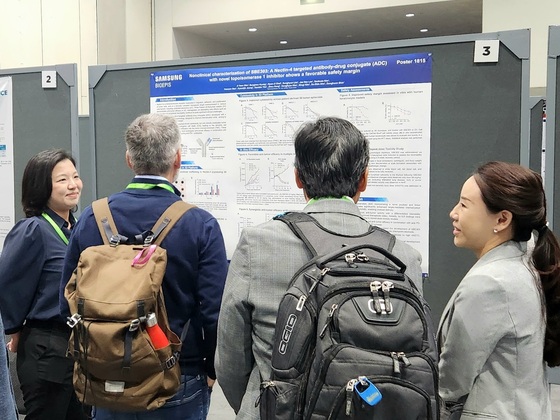
Samsung Bioepis announced on Tuesday that it has unveiled research data for its antibody-drug conjugate (ADC) new drug SBE303 at the Annual Meeting of the American Association for Cancer Research (AACR 2026) currently underway in San Diego, California.
SBE303 is a next-generation ADC cancer treatment targeting the nectin-4 protein, which is overexpressed in tumor cells.
This represents the first new drug pipeline developed through collaborative research and licensing agreements with domestic and international partners as part of Samsung Bioepis’s open innovation strategy.
Studies have shown that SBE303 demonstrates improved tumor cell binding specificity and drug delivery efficiency compared to existing nectin-4 targeted therapies.
In safety evaluations, SBE303 exhibited better results in skin toxicity tests, a common side effect of current nectin-4 targeted therapies. Notably, no cases of interstitial lung disease (ILD), a serious side effect that can cause irreversible damage, were observed.
Furthermore, the highest no-observed-adverse-effect level (NOAEL) was determined to be 40 mg/kg, indicating a wide therapeutic index and supporting the potential for SBE303’s clinical application.
Dr. Shin Dong-hoon, Vice President and Head of Clinical Medicine at Samsung Bioepis, stated that these research findings reaffirm the expertise in developing antibody drugs. He added that through further clinical trials of SBE303, it aims to continue exploring its potential as a next-generation ADC cancer treatment with proven efficacy and safety, addressing various unmet medical needs.
Meanwhile, Samsung Bioepis has initiated global Phase 1 clinical trials for SBE303 in the U.S. and South Korea. From March to July 2030, the company plans to evaluate the drug’s safety and initial efficacy in 149 patients with advanced refractory solid tumors.