

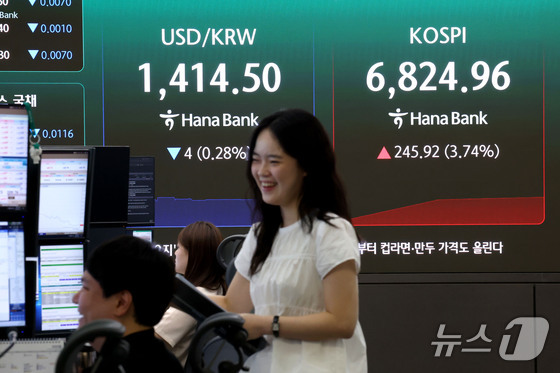
The USD-to-KRW exchange rate has dipped into the early 1,410 KRW (about 1.00 USD) range following the release of the U.S. July Consumer Price Index (CPI), which met market expectations.
As of 9:22 a.m. (Korean time) on Thursday, the Seoul foreign exchange market saw the USD-to-KRW rate trading at 1,413.4 KRW (about 1.00 USD), down 2.3 KRW (about 0.0017 USD) from the previous day’s closing price of 1,415.7 KRW (about 1.06 USD) at 3:30 p.m. (Korean time).
The July CPI report showed a 3.4% year-over-year increase and a 0.1% month-over-month rise, in line with market forecasts. The core CPI, which excludes volatile food and energy prices, also matched expectations, climbing 2.5% year-over-year and 0.2% month-over-month.
In the wake of the CPI announcement, U.S. Treasury yields initially fell, briefly weakening the dollar. However, the greenback bounced back as long-term bond yields reversed course and began to climb.
Upward pressure on the exchange rate has been further fueled by rising global oil prices and geopolitical tensions in the Middle East. West Texas Intermediate (WTI) crude oil edged up 0.08% to 83.27 USD per barrel. Ongoing concerns about U.S.-Iran negotiations over the Strait of Hormuz are expected to maintain upward pressure on the exchange rate.
The yen’s weakness is likely to put additional strain on the won. Overnight, the dollar-yen rate surged to around 159.4 JPY (about 1.00 USD), nearing the 160 JPY (about 1.07 USD) threshold. However, as it approaches this level, the heightened risk of intervention by Japanese monetary authorities may cap further gains.
Domestically, demand from importers settling payments and residents exchanging currency for overseas stock investments is expected to provide support for the lower end of the exchange rate.
Conversely, foreign investors’ net buying in the local stock market and exporters’ dollar sales are anticipated to curb any significant upswings. The strong performance of semiconductor stocks in the U.S. markets overnight could potentially attract continued foreign capital inflows to South Korean equities.
Moon Jeong-hee, an economist at KB Kookmin Bank, noted that following last week’s weak July employment data and now the slowdown in consumer prices, expectations for further rate hikes by the Federal Reserve have diminished considerably. If oil prices stabilize and softer employment eases demand-driven inflationary pressures, it could see a significant reduction in dollar demand that had been predicated on high U.S. interest rates.