

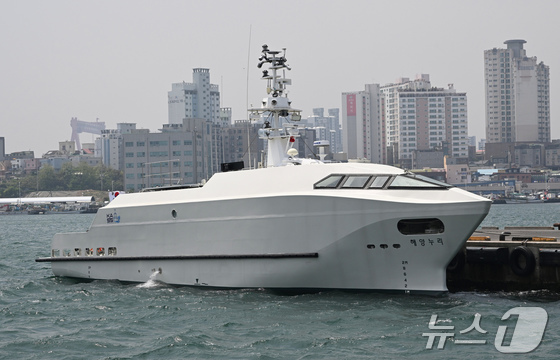
The Ministry of Oceans and Fisheries, led by Minister Hwang Jong-woo, announced on Tuesday the launch of the IMO Maritime Autonomous Surface Ships (MASS) Response Council. This initiative aims to systematically address the development of international standards for autonomous vessels in collaboration with the shipping and shipbuilding industries, academia, and research institutions.
Efforts to develop technologies and establish international standards for the commercialization of autonomous vessels are in full swing both domestically and internationally. In May, the International Maritime Organization (IMO) adopted non-mandatory regulations for autonomous ships, with the goal of implementing mandatory regulations by 2030. To enhance its technological competitiveness, South Korea has also begun similar initiatives, such as the Artificial Intelligence (AI) Fully Autonomous Vessel Technology Development Project, which commenced in August this year and is set to run from 2026 to 2032.
The newly operational Response Council comprises 20 key organizations, including the Ministry of Oceans and Fisheries, the Korean Register of Shipping, the Korea Research Institute of Ships and Ocean Engineering, and representatives from the shipping and shipbuilding sectors and academia.
The council will disseminate the latest developments in IMO discussions on autonomous vessels to industry, academia, and research institutions to support domestic technology development. It will also identify aspects of domestic research and development achievements that can be incorporated into international standards, propose them as IMO agenda items, and coordinate responses at international conferences. This approach aims to increase the integration of domestic technologies into international standards and enable the industry to adapt effectively to these standards.
Jung Do-hyun, Director of the Maritime Safety Bureau at the Ministry of Oceans and Fisheries, stated that the international standards for autonomous vessels significantly impact the shipping and shipbuilding industries. It’s crucial to actively incorporate domestic technologies and experiences. It will unite the capabilities of industry, academia, and research to play a leading role in discussions on international standards and bolster the competitiveness of the domestic industry.
Maritime Autonomous Surface Ships (MASS) refer to high-value vessels capable of navigating independently without crew intervention by integrating advanced technologies such as AI, the Internet of Things (IoT), and big data.