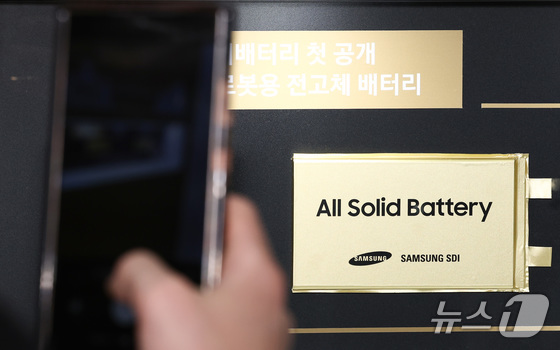
Secondary battery stocks are experiencing a strong rally while major semiconductor stocks have stalled. Investors, who were initially focused on semiconductors, are now turning their attention to secondary batteries. This shift is driven by growing expectations for increased energy storage system (ESS) demand, fueled by the expansion of artificial intelligence (AI) data centers.
The Korea Exchange reported on Monday that as of 10:31 a.m. (KST), Samsung SDI was trading at 576,000 KRW (about 432 USD), up 46,000 KRW (about 35 USD) (8.68%) from the previous trading day.
Other key players in the secondary battery sector also saw gains, including Posco Future M up 8.04%, EcoPro up 7.26%, LG Energy Solution up 5.46%, and L&F up 4.59%.
Secondary battery stocks have shown resilience amid recent market downturns. LG Energy Solution, for instance, has surged nearly 20% this month, starkly contrasting the KOSPI index’s decline of over 16% during the same period.
Market analysts attribute this strength to the surge in ESS demand driven by AI data center expansion, which has bolstered performance expectations for companies in this sector. The battery industry, previously hampered by slowing electric vehicle demand, is now finding new growth potential in ESS, leading to improved investor sentiment.
On October 8, LG Energy Solution announced that its preliminary third-quarter operating profit reached 756 billion KRW (about 567 million USD), marking a 25.7% year-over-year increase and an impressive 567.3% jump from the previous quarter.
Han Ji-young, an analyst at Kiwoom Securities, observed that as large-cap stocks like semiconductors find support, it’s witnessing a shift of capital into mid and small-cap stocks on the KOSDAQ. Sectors such as semiconductor materials, components, and equipment, along with secondary batteries and biotech, are showing particular strength.
Kim Kwi-yeon, an analyst at Daishin Securities, maintained a buy recommendation for the secondary battery sector, stating that the momentum from year-end orders, coupled with projected improvements in ESS sales and profitability next year, continues to drive these stocks.
Furthermore, reports of potential increased U.S. tariffs and stricter supply chain regulations on Chinese batteries have sparked speculation that Chinese ESS manufacturers might exit the U.S. market, further boosting investor confidence in non-Chinese battery makers.