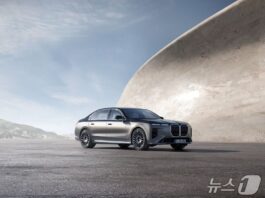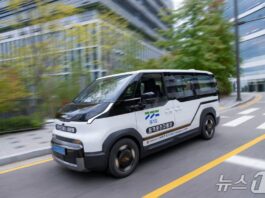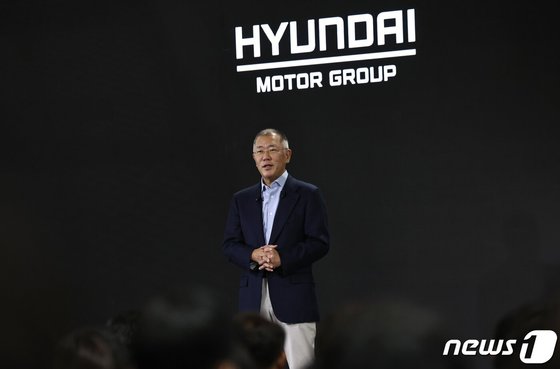
Hyundai Motor Group has consistently chosen the United States as the global launch pad for its new vehicles. Following the unveiling of Genesis’ flagship electric sport utility vehicle (SUV), the GV90, the company also debuted the all-new fifth-generation Tucson in the U.S. This strategy underscores Hyundai’s commitment to its largest market.
Meanwhile, Volkswagen Group, which had heavily invested in China, has slashed its operating profit forecast to a maximum of 1% due to plummeting local sales. The contrasting fortunes of these two automakers, both grappling with China risk, highlight the impact of their strategic focus on either the U.S. or China. Industry analysts are praising Hyundai Chairman Euisun Chung’s U.S.-centric gambit as prescient.
Industry sources reported on Monday that Genesis unveiled the GV90 and GV90 Neoroon for the first time in San Francisco last August. Chairman Chung personally attended the launch event, his first such appearance in over three years since the Ioniq 5 N debut in July 2023.
Earlier this month, Hyundai hosted approximately 160 global media representatives in New York to showcase the new Tucson. Hyundai Motor President Jose Munoz emphasized that the U.S. is Hyundai’s most crucial market, with New York being its most iconic city.
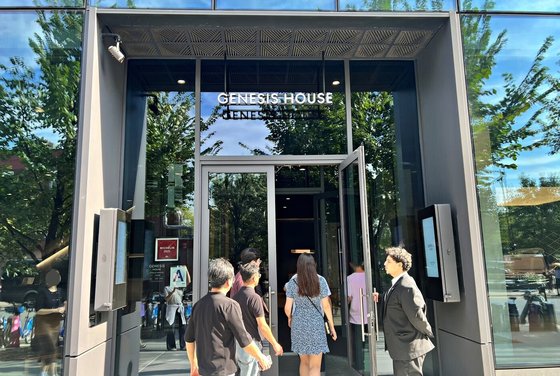
A quarter of global sales stem from the U.S., with Genesis gaining traction. The U.S. market’s significance is reflected in Hyundai’s performance metrics. Last year, Hyundai and Kia sold a record-breaking 1,836,172 vehicles in the U.S., capturing over 11% market share for the first time (11.3%). This represents about a quarter of the group’s total global sales of 7,273,983 vehicles.
The momentum has accelerated this year. While Hyundai and Kia’s global wholesale sales in Q2 dipped by about 2% to 1,843,524 units year-over-year, U.S. sales surged by 3.5% to 489,663 units, setting a new Q2 record.
Genesis exemplifies the U.S. market’s importance most vividly. Since its 2016 U.S. launch, Genesis has sold 454,049 vehicles cumulatively through July this year. It surpassed 80,000 annual sales (82,331 units) for the first time last year, marking five consecutive years of record sales. This year’s first-half sales hit an all-time high of 39,088 vehicles. The brand’s success in the U.S. luxury market, long dominated by Lexus, BMW, and Mercedes-Benz, validates its market value.
Volkswagen’s Fall from 15-Year Reign as China’s No. 1… China Equity Earnings Plunge 78%
Volkswagen Group took a divergent path. Despite holding China’s top sales position from 2008 to 2022, it has been outpaced by local competitors like BYD in the electric vehicle sector. Its China sales plummeted from 4.23 million units in 2019 to 2.69 million last year. Profits from Chinese joint ventures nosedived by 78.4%, from 4.425 billion EUR (about 4.97 billion USD) to 958 million EUR (about 1.07 billion USD) in the same period.
The outlook remains grim this year. Volkswagen’s China deliveries from January to September totaled 1,378,800 vehicles, a steep 30.2% year-over-year decline. Last month, Volkswagen downgraded its annual operating profit forecast from 4.0-5.5% to a maximum of 1%, factoring in a 6 billion EUR (about 6.7 billion USD) impairment related to Porsche.
Hyundai Motor Group has also weathered challenges in China. In 2016, Hyundai and Kia’s China sales peaked at 1.79 million vehicles, constituting 23% of their global sales. However, sales plummeted following the 2017 Terminal High Altitude Area Defense (THAAD) crisis. Their combined market share, once approaching 10%, dwindled to below 1% last year.
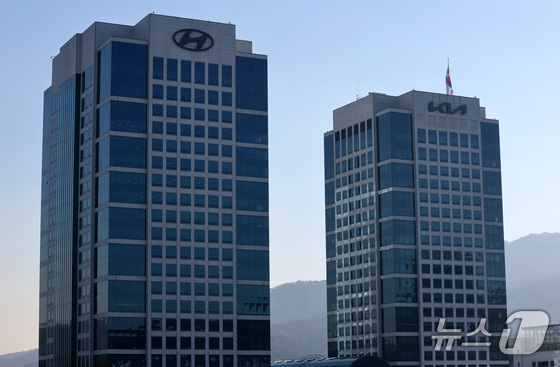
Cutting China Production After THAAD Shock to Build Resilience… Expanding U.S. Manufacturing
Hyundai Motor Group opted for decisive action over regret. It divested its Beijing Plant 1 in 2021 and Chongqing plant in 2023. The idle Changzhou plant is also being phased out. Once operating eight passenger car plants in China (five Hyundai, three Kia), the group now maintains just four.
China’s contribution to group sales has diminished to 3% by 2024. Analysts suggest that this early downsizing shielded the group from recent Chinese market contractions, allowing resource reallocation to the U.S. market.
Indeed, Hyundai Motor Group’s Georgia facility, Meta Plant America (HMGMA), aims to boost annual production capacity to 500,000 vehicles by 2028. President Jose Munoz has even hinted at potentially increasing this to 700,000-800,000 vehicles by 2028.
An industry insider noted that as Hyundai Motor Group zeroes in on the U.S. market, it’s gaining ground on Ford. However, the company’s expressed intent to re-enter China suggests potential shifts in its strategy there.