

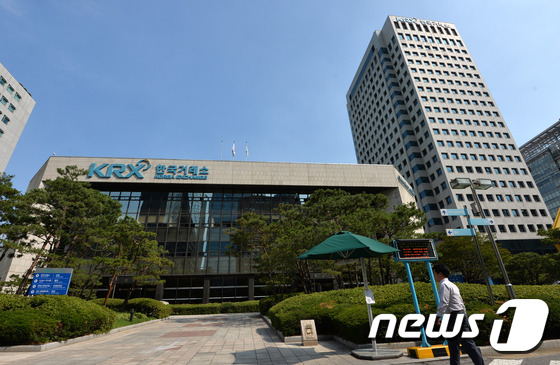
The Korean domestic stock market has initiated efforts to shorten the stock settlement cycle by one day. While there are concerns that reducing settlement preparation time could increase failure rates, data from the U.S. and Canada—which recently transitioned from T+2 to T+1 systems—show that their settlement failure rates have remained stable post-transition.
On Monday, the Korea Exchange and affiliated securities institutions unveiled a draft roadmap to shorten the current settlement cycle from two business days after the trade date (T+2) to the next business day (T+1). The exchange aims to implement this transition by the fourth quarter of 2028, planning to upgrade infrastructure and conduct comprehensive stability tests.
A shorter settlement cycle means buyers must prepare funds a day earlier, while sellers need to transfer securities more quickly. This could potentially increase settlement failures if sellers can’t deliver securities or buyers can’t make payments on time, leading to delays or postponements. Foreign investors face additional challenges due to time zone differences in transaction confirmations and currency exchanges.
The exchange reports that the current settlement failure rate in the domestic stock market is approximately 0%, the lowest globally. In contrast, the U.S. and Europe, which adopted T+1 systems earlier, report failure rates of 2-3% and 7%, respectively.
Since implementing the T+1 system in May 2024, the U.S. has not seen a significant increase in settlement failure rates. The U.S. Depository Trust & Clearing Corporation (DTCC) reported that the Continuous Net Settlement (CNS) failure rate averaged 2.12% in July 2024. The non-CNS failure rate was 3.31%, with DTCC noting that both metrics are comparable to averages under the previous T+2 system.
Transaction confirmation speeds have improved markedly. The percentage of confirmations completed by 9:00 p.m. (KST) on trade day rose from 73% in late January 2024 to about 95% post-transition. The NSCC clearing fund, which mitigates settlement risks, decreased from an average of 12.8 billion USD pre-transition to 9.8 billion USD post-transition, a 23% reduction. This decrease in collateral requirements reflects the shorter duration of unsettled transactions.
Canada, which adopted T+1 just a day after the U.S., has also reported no significant deterioration in settlement performance. The Canadian Depository for Securities (CDS) indicates that post-transition settlement failure rates remain consistently below 2%, in line with previous levels. An Ontario Securities Commission (OSC) analysis from January 2021 to June 2025 found no meaningful changes in the proportion of securities with settlement failures or the value of failed settlements relative to total transaction volumes.
Major markets, including the U.S. and Canada, allowed several years for preparation before transitioning. The preparation period from roadmap announcement to implementation was approximately 2.5 years in the U.S., 2.7 years in the UK, and over 3 years in Hong Kong. The UK and Hong Kong set target schedules, with Hong Kong postponing its implementation from late 2027 to late 2028. Korea aims to complete its transition in about 2.1 years.
The exchange will gather feedback on this draft until December 18. It plans to provide industry-specific operational standards and implementation checklists next month. In the first quarter of next year, it will establish a task force with relevant agencies and a Project Management Office to oversee development and testing schedules.
The exchange and depository aim to complete the overhaul of clearing and settlement infrastructure by October next year, supporting financial firms in finalizing their IT and operational system adjustments by Q1 2028. Subsequently, they will conduct comprehensive market-wide tests for at least six months.
An exchange official emphasized that to maintain our exemplary settlement stability while successfully shortening the settlement cycle, it needs ample time for preparation and thorough testing.