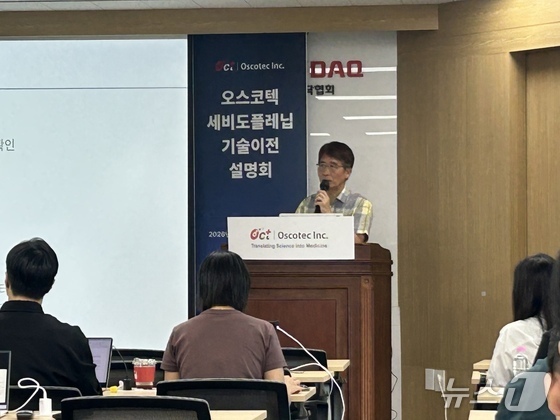
It feels like it’s sent Cevidoplenib off to be married, said Yoon Tae-young, Chief Executive Officer (CEO) of Oscotec, during a briefing on Cevidoplenib’s technology export held on Thursday at the KOSDAQ Association in Yeouido, Seoul. He added that Cevidoplenib is expected to see even greater growth in the global market.
Oscotec recently inked a technology transfer agreement for the autoimmune disease drug candidate Cevidoplenib with Agios Pharmaceuticals, Inc., a U.S. company specializing in rare disease treatments.
Cevidoplenib is an oral small-molecule synthetic drug candidate that selectively inhibits spleen tyrosine kinase (SYK), jointly discovered and developed by Oscotec and Genosco.
Oscotec will receive a non-refundable upfront payment of 25 million USD from Agios. Depending on the specifics of the agreement, they could secure up to 665 million USD in total through milestone payments at various stages of development, approval, and commercialization. Post-commercialization, they will also receive additional royalties.
During the event, CEO Yoon emphasized the partner’s capabilities over the contract size. He explained that for Cevidoplenib to succeed globally, they needed a company with both development and commercialization experience. Agios, he noted, has a track record in drug development, approval, and commercialization in the rare blood disease sector.
Agios is a global biopharmaceutical firm focused on developing and commercializing treatments for rare diseases. Their key pipeline includes mitapivat, which activates pyruvate kinase (PK).
Based in Cambridge, Massachusetts, Agios has successfully obtained the U.S. Food and Drug Administration (FDA) approval for Acute Myeloid Leukemia (AML) treatments IDHIFA and TIBSOVO. They are currently concentrating on developing and commercializing treatments for rare blood disorders.
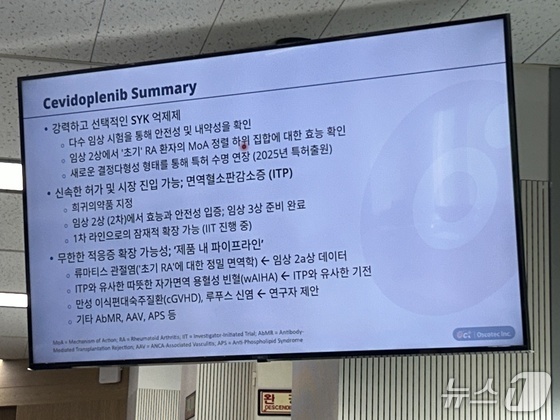
Moving forward, Agios will spearhead the global development of Cevidoplenib. They plan to launch Phase 3 clinical trials for immune thrombocytopenia (ITP) and pursue further clinical studies to expand its indications.
Cevidoplenib works by selectively inhibiting SYK, which is overexpressed in various immune cells like B cells and macrophages. This mechanism blocks inflammation caused by autoantibodies early on, potentially offering excellent efficacy and safety for various autoimmune diseases.
The 2023 Phase 2 clinical trial results for ITP demonstrated Cevidoplenib’s strong competitive edge in safety, tolerability, and efficacy.
Cevidoplenib’s journey began in 2014 when it was selected as a Korea Drug Development Fund (KDDF) project. Since then, it has progressed from candidate discovery to completing two Phase 2 clinical trials for ITP and RA patients. In 2024, it received orphan drug designation from the FDA for ITP treatment.
Currently, researchers are conducting a clinical trial to assess its potential as a first-line ITP treatment, alongside a bioequivalence study for a new drug formulation.
CEO Yoon described Cevidoplenib not just as a single-indication treatment, but as a Pipeline in a Product.
He stressed that Cevidoplenib is a versatile asset with potential applications beyond a single disease, highlighting significant opportunities for expanding its indications in the future.
Even after the technology transfer, Oscotec plans to continue supporting Cevidoplenib’s development. This includes completing ongoing bioequivalence trials and backing researcher-led clinical trials for ITP.
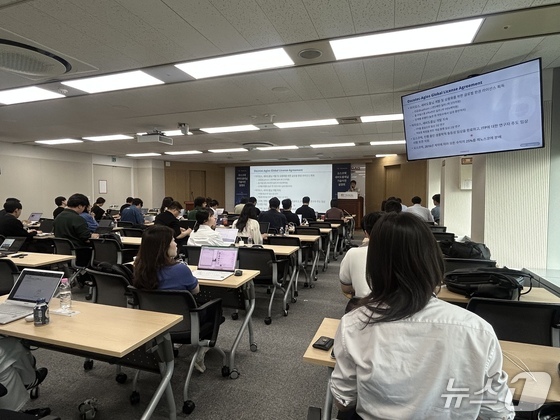
While Agios will lead global development and commercialization efforts, Oscotec stands to benefit from milestone payments and sales royalties. As per a 2016 agreement, Oscotec will share 25% of Cevidoplenib-related revenues with its affiliate, Genosco.
This deal underscores the global recognition of a domestically developed drug candidate’s value.
CEO Yoon reflected that it’s married off or engaged all the legacy pipelines. For the next 2-3 years, it’ll focus entirely on developing anti-resistance cancer drugs and fibrosis treatments. It’s expanding the research facilities and pipeline, with plans to explore new modalities by 2030.