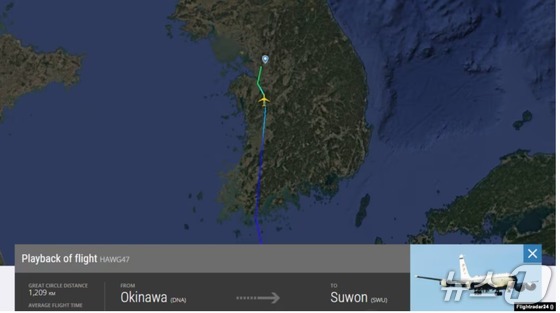
The U.S. Air Force’s RC-135U Combat Sent, a rare strategic electronic intelligence (ELINT) reconnaissance aircraft with only two in operation worldwide, was detected spending an unusually long period of about 30 hours in South Korea before relocating to Okinawa, Japan. This extended stay is considered exceptional for the Combat Sent. According to flight tracking data from FlightRadar24 analyzed by Voice of America (VOA), the Combat Sent entered South Korean airspace over the South Sea on June 26 at 7:53 a.m. (Korean time). It then disappeared from radar near Suwon, Gyeonggi Province, at 8:14 a.m. (Korean time) as it lowered its altitude. The aircraft resurfaced on radar near Osan around 2:48 PM on the 27th, approximately 30 hours later. It then ascended and landed at Kadena Air Base in Okinawa at about 5:00 p.m. (Korean time) the same day. While the public flight data suggests a 30-hour stay in South Korea, it’s unclear whether the aircraft conducted additional flights or remained grounded during the period it was off radar. VOA reports that the Combat Sent typically deploys to the Korean Peninsula two to three times annually. However, these missions usually involve several hours of flight near the Military Demarcation Line (MDL) or over the East and West Seas before returning to Okinawa. On its most recent mission on June 12, the aircraft’s signal vanished for about 1 hour and 40 minutes over central Korea before heading back to Okinawa. The RC-135U Combat Sent is a specialized ELINT platform operated by the U.S. Air Force. It’s capable of collecting and analyzing ground radar emissions, military communications, and various electronic signals from hundreds of kilometers away. Its primary mission includes detecting missile launch preparations and tracking ballistic missile flight characteristics. North Korea has consistently shown sensitivity to Combat Sent deployments near the Korean Peninsula. In a 2024 statement, North Korea’s state-run Korean Central News Agency criticized U.S. reconnaissance activities, specifically mentioning the Combat Sent and claiming these operations escalate military tensions in the region.
Analysts suggest that the Combat Sent’s recent extended mission could be related to North Korea’s deployment of various upgraded ballistic missiles to its frontline units. This move by North Korea, involving the positioning of previously undisclosed ballistic missiles near the border, has heightened tensions and may have prompted increased surveillance activities.
As of now, South Korean and U.S. intelligence agencies are reportedly still analyzing the exact specifications of the new warhead-equipped ballistic missile launched by North Korea on June 25.