

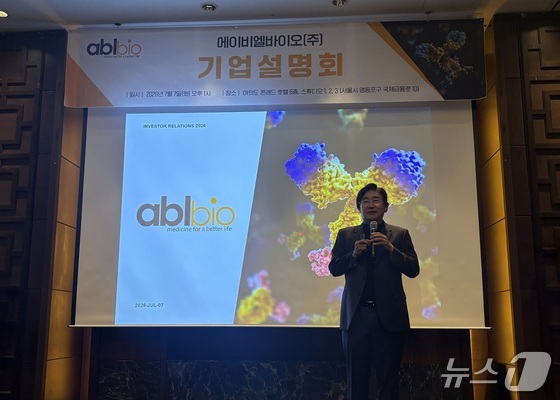
ABL Bio said it will begin a global Phase 3 clinical trial of its bispecific antibody candidate ABL111 for gastric cancer in December, accelerating development after reaching an agreement with the U.S. Food and Drug Administration (FDA) to move directly into a pivotal trial without conducting a Phase 2 study.
Speaking at a press briefing in Seoul on Monday, Lee Sang Hoon, CEO of ABL Bio, said the company received FDA agreement to proceed directly to Phase 3 following completion of the Phase 1 trial.
“We plan to initiate the registrational Phase 3 trial in December this year,” Lee said.
ABL111 is a bispecific antibody targeting both Claudin 18.2 and 4-1BB. The company is developing the candidate with partner NovaBridge as a first-line treatment for gastric cancer.
ABL Bio had originally planned to conduct a Phase 2 study before advancing to Phase 3 but revised its strategy to accelerate development as Astellas Pharma has already established an early lead in the Claudin 18.2-targeted therapy market.
“If we had proceeded through Phase 2 before starting Phase 3, final data might not have been available until 2032,” Lee said. “With this approach, we expect to complete Phase 3 data collection by late 2029 or 2030.”
The company believes ABL111 could differentiate itself from existing Claudin 18.2-targeted therapies through an improved safety profile and broader patient eligibility.
“Although Astellas’ zolbetuximab has already been approved, gastrointestinal side effects remain a concern,” Lee said. “Current data suggest ABL111 is competitive not only in efficacy but also in safety.”
Phase 1 clinical data for ABL111 will be presented at this year’s European Society for Medical Oncology (ESMO) Congress.
ABL Bio said one of the therapy’s key advantages is its potential activity in patients with low Claudin 18.2 expression and those with low PD-L1 expression.
The company also highlighted its Grabody-B blood-brain barrier (BBB) shuttle platform as another major growth driver.
ABL Bio is currently collaborating with Sanofi, GSK, and Eli Lilly on BBB shuttle technologies.
“Our collaborations with GSK and Lilly are progressing faster than expected,” Lee said. “Lilly, in particular, has been highly proactive in advancing the joint research.”
Regarding ABL301, which is being co-developed with Sanofi, Lee said the company has received written confirmation that there are no issues preventing further clinical development.
“Sanofi informed us that it plans to resume clinical development once biomarker preparations are complete and emphasized that the program has not been discontinued,” he said.
ABL Bio also plans to expand the BBB shuttle platform beyond antibodies to include small interfering RNA (siRNA), enzymes, and fusion proteins.
“Development of our next-generation BBB shuttle is already underway,” Lee said. “Global pharmaceutical companies increasingly view BBB shuttle technologies as a key strategic platform for central nervous system diseases.”
In the antibody-drug conjugate (ADC) field, the company is advancing ABL206 and ABL209 through its U.S. subsidiary Neok Bio.
Both candidates have entered the second cohort of their Phase 1 trials, with completion of Phase 1 expected around next summer.
Lee also signaled plans to expand partnerships with Chinese biotechnology companies.
“China has become exceptionally fast at antibody discovery and early-stage clinical development,” he said. “We intend to actively leverage partnerships in China across various modalities, including ADCs.”
Looking ahead, Lee said ABL Bio aims to evolve beyond a traditional licensing company.
“Our ultimate goal is not simply to out-license technologies, but to become a company that shares in commercialization revenues alongside global pharmaceutical partners,” he said. “Companies such as Regeneron, Genmab, and China’s Innovent Biologics represent the model we aspire to follow.”