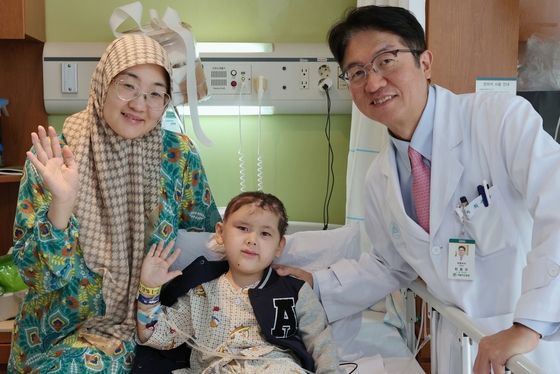
“Now that I’m returning to school, I’ll study hard and read lots of books. I’m truly grateful to all the doctors who treated me.”
A 6-year-old boy from Kyrgyzstan, who suffered 80% scalp damage and skull exposure after an attack by three large dogs, has returned home healthy after receiving treatment in Korea. He can now pursue his dream of becoming a pilot and his modest wish to study and read books at school again.
Seoul Asan Medical Center reported on Wednesday that a team led by Dr. Choi Jong-woo successfully treated Umar, a 6-year-old patient from Kyrgyzstan who had suffered severe scalp damage from a dog attack.
Umar, who flew for the first time in his life for treatment, returned home healthy on October 15, still holding onto his dream of becoming a pilot. This remarkable journey began six months ago when he serendipitously connected with medical staff from Seoul Asan Medical Center, who were in Kyrgyzstan to share medical expertise.
Kyrgyzstan, situated in northeastern Central Asia, is predominantly mountainous, with about 80% of its terrain being high-altitude. The complex geography makes transportation difficult, and the healthcare infrastructure is inadequate, often preventing residents from receiving timely and appropriate medical care.
On April 1, Umar, who lived in Bishkek, the capital of Kyrgyzstan, was playing with friends at a neighbor’s house. While climbing back over the fence to return home, he lost his balance and fell into an adjacent yard. At that moment, large dogs in the yard attacked him.
The dog attack left Umar with severe scalp injuries, exposing his skull. An area measuring 25 cm by 25 cm was damaged, resulting in the loss of about 80% of his scalp and fracturing his skull.
A patrolling police officer discovered Umar and rushed him to a nearby hospital. However, the medical staff there were at a loss, saying they had never seen such a case before and indicating that treatment would be challenging. Umar only received antibiotics to prevent infection.
Umar’s parents even considered taking him to Turkey for treatment, but the combined cost of air travel and surgery would have been about 100,000 USD. This amount was far beyond the means of the family, who relied on a monthly pension of about 300,000 KRW (about 227 USD).
A breakthrough came when local medical staff reached out to their Korean counterparts for help. Coincidentally, a team of four medical professionals, including Dr. Seo Hyun-seok from Seoul Asan Medical Center, had been conducting a five-day medical technology transfer program at a national hospital in Bishkek since the 25th.
After examining Umar at the national children’s hospital where he was admitted, Dr. Seo determined that treatment in Korea would be the best option.
Umar’s scalp damage was extensive, with his skull exposed, raising serious concerns about complications, Dr. Seo explained. Given the complexity of the required surgery, which would be difficult to perform locally, it decided it would be best to transfer him to Korea for treatment.
Umar arrived in Korea on July 9 and underwent comprehensive pre-surgical examinations at Seoul Asan Medical Center.
Dr. Choi initially considered using skin tissue from Umar’s thigh and abdomen to cover his scalp and reconnect microvessels. However, due to Umar’s young age and small frame, it was challenging to secure enough tissue to reconstruct the extensive damaged area. Moreover, using tissue from other body parts would have left those areas permanently hairless.
Dr. Choi’s team decided to perform skin grafting and tissue expansion surgery in stages, not only to cover the scalp but also to consider the child’s future quality of life as he grows.
Tissue expansion involves inserting a silicone expander under the skin and gradually injecting saline to stretch the skin and scalp. This technique allows for covering the damaged area while preserving as much hair-growing tissue as possible.
However, Umar had less than 20% of his scalp tissue remaining, leaving insufficient space to insert the tissue expander.
To address this, the team first grafted skin from Umar’s thigh to cover part of the damaged area and create space for the tissue expander. They then performed surgery to insert three tissue expanders into the remaining scalp.
Over the next two months, they gradually expanded the scalp, carefully controlling the injection rate to prevent damage to the expanders.
During the treatment, they faced challenges such as wound separation and fever, but a multidisciplinary team including dermatologists, pediatric infectious disease specialists, and radiologists collaborated to provide focused care.
After a meticulous tissue expansion process, they successfully completed reconstructive surgery on September 29, using the expanded scalp to cover the exposed skull.
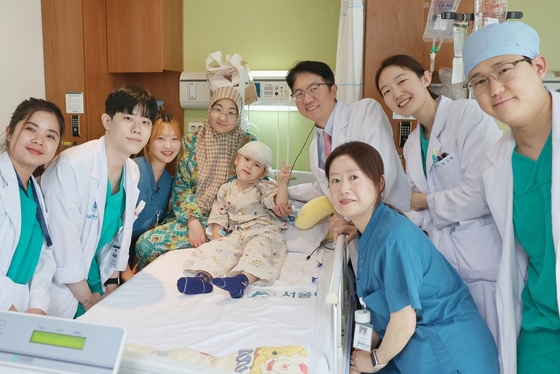
All costs associated with Umar’s treatment were fully covered by the Asan Social Welfare Foundation and Seoul Asan Medical Center. The Eastern Foreign Residents Center in Seoul provided crucial translation support throughout the treatment process.
In Umar’s case, the extensive scalp loss made it challenging to decide on a reconstruction method, Dr. Choi stated. It chosed to utilize as much of the remaining scalp as possible, considering not only the immediate need to cover the damaged area but also the child’s future growth and development.
He added that it hopes Umar, who showed remarkable resilience and cheerfulness throughout this difficult journey, continues to thrive and achieve his dreams after returning home.
Umar’s mother, Narkiza (41), expressed her heartfelt gratitude: They were devastated to hear there was no treatment available in Kyrgyzstan, but it was truly miraculous to meet the doctors at Seoul Asan Medical Center. Thanks to their expertise and compassion, it’s returning home with memories filled with hope and gratitude.
Seoul Asan Medical Center, since its founding in 1989, has established itself as a leader in treating severe diseases and performing complex surgeries. It operates three specialized hospitals – for cancer, heart disease, and pediatrics – along with over 50 specialized centers. The hospital continues to advance treatment for severe conditions and conduct cutting-edge research in fields such as cancer, organ transplantation, and cardiovascular disease.
Furthermore, through its Asan-in-Asia project, the hospital supports medical self-sufficiency in Asian countries, sharing medical expertise in nations like Mongolia and Vietnam, thus fostering international medical cooperation.