

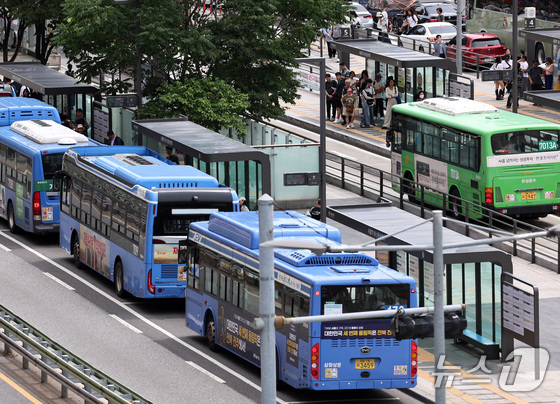
The Ministry of Land, Infrastructure and Transport’s Metropolitan Area Transport Commission (MTC) will discuss ways to build future transit systems using examples of transit centers in the U.S. and Hong Kong and emerging technologies such as artificial intelligence (AI) and digital twins.
The MTC said Sept. 9 that it will hold the fourth Metropolitan Area Transit Innovation Forum in Yongsan, Seoul, on the afternoon of Sept. 10.
The forum’s theme is “Connected Mobility, Connected Regions.”
Now in its fourth year, the forum aims to improve service levels for faster and more convenient transfers and expand social consensus around such improvements. This year, overseas experts will be invited for the first time to share successful transit examples and the latest technology trends. About 200 officials and experts from the transport ministry, local governments, research institutes, academia and industry will participate.
The forum will examine transit center policies and actual development cases in the U.S. and Hong Kong and present development directions for intelligent future transit centers using the latest technologies, including AI and digital twins.
R. Jayakrishnan, a professor at the University of California, Irvine, who will deliver the keynote address, will present a vision for metropolitan transportation innovation led by future transit centers under the theme “Connected Mobility, Connected Regions Through Future Transit Centers.”
Professor Jang Sung-hoon of The Hong Kong Polytechnic University will analyze the Hong Kong MTR case, which achieved a 90% public transit share by combining user-centered transfer design with transit-oriented development (TOD), and propose ways to apply the approach to South Korea’s transit policies.
Specifically, Jang will explain Hong Kong MTR’s proactive planning, unified governance and financing methods.
Tiantian “Nicole” Chen, a professor at the Korea Advanced Institute of Science and Technology (KAIST), will introduce personalized optimal-route guidance technology using AI that comprehensively considers travel time, accident risks and transfer fatigue.
Janet Lee, a senior manager at Hong Kong MTR, will present Hong Kong’s use of digital twin technology from the planning stage of transit facilities to improve passenger-flow management and operational efficiency and enhance the user experience, along with future development directions.
Finally, Son Seung-oh, a senior researcher at the Korea Railroad Research Institute, will introduce ways to predict and manage congestion in transit centers in advance using vision AI and digital twin technologies and present development directions for intelligent future transit centers.
After the presentations, experts from the Seoul Institute, Gyeonggi Research Institute, Korea Transport Institute, Korea Railroad Research Institute and Korea Institute of Civil Engineering and Building Technology will participate in a panel discussion and Q&A on various future transit policies.
Kim Yong-seok, chairman of the MTC, is expected to say, “It is more important than ever to build technology-intensive, advanced transfer systems centered on major transportation hubs and improve the level of services provided to the public. We will faithfully reflect the overseas best practices and expert recommendations shared at the forum in future transit policies and build a transfer system that everyone can use quickly and conveniently.”