

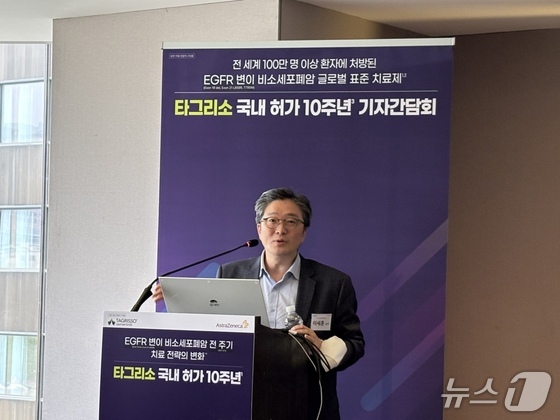
Over the past decade, treatment for EGFR mutation-positive non-small cell lung cancer (NSCLC) has seen rapid advancements, primarily driven by third-generation EGFR-TKIs. Tagrisso (osimertinib) has been at the forefront of this paradigm shift, according to Lee Hyun-joo, Executive Director of the Oncology Business Unit at AstraZeneca Korea. Lee made these remarks during a press conference held on Tuesday at the Plaza Hotel in Seoul, commemorating the 10th anniversary of Tagrisso’s approval in South Korea.
The conference aimed to review the expanded treatment scope since Tagrisso’s introduction in Korea, highlight key global clinical outcomes, and outline future research and development directions in lung cancer treatment.
EGFR mutation-positive NSCLC is the most prevalent form of non-small cell lung cancer, resulting from mutations in the epidermal growth factor receptor (EGFR) gene. It predominantly affects Asian populations, non-smokers, and women.
Tagrisso first received approval in South Korea in 2016 as a second-line treatment for patients with locally advanced or metastatic NSCLC harboring the EGFR T790M mutation. Since then, its indications have expanded to include first-line monotherapy, combination chemotherapy, adjuvant therapy for stages IB to IIIA post-surgery, and treatment for patients with unresectable locally advanced disease.
To date, Tagrisso has been administered to over 1 million patients worldwide, accumulating substantial clinical evidence through various global studies.
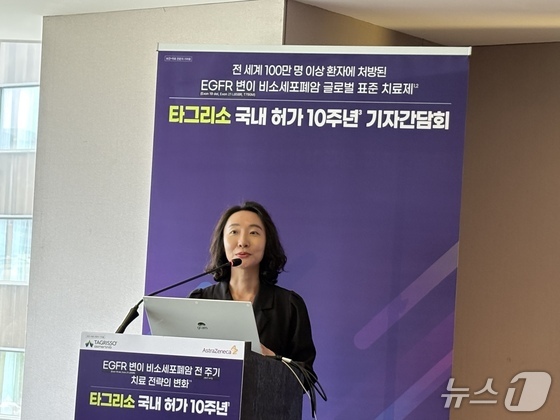
Tagrisso Plus Chemotherapy Demonstrates Long-Term Survival Exceeding Four Years
During the event, Professor Lee Se-hoon from Samsung Medical Center’s Department of Hematology and Oncology presented on the evolving treatment strategies for EGFR mutation-positive NSCLC.
Professor Lee explained that over the past decade, the treatment landscape for EGFR mutation-positive NSCLC has evolved in tandem with the expansion of Tagrisso’s indications. He emphasized that results from major global clinical studies have been instrumental in developing treatment strategies tailored to specific disease stages and patient characteristics.
Lee highlighted that following Tagrisso’s introduction as a second-line treatment for patients with EGFR T790M mutations in the AURA3 study, the FLAURA study confirmed improvements in overall survival (OS) and progression-free survival (PFS) for first-line treatment of advanced EGFR mutation-positive NSCLC, establishing it as a key treatment option.
Furthermore, he noted that the FLAURA2 study recorded a median overall survival of 47.5 months for patients receiving Tagrisso in combination with chemotherapy, demonstrating long-term survival approaching four years. Consistent clinical outcomes were also observed in patients with central nervous system metastases compared to the control group.
Lee added that the ADAURA study indicated potential reductions in recurrence or death risk with post-surgical adjuvant therapy, while the LAURA study confirmed significant PFS extension in patients with unresectable locally advanced disease, highlighting opportunities for expanding treatment strategies.
Ji Ji-yoon, Executive Director of the Medical Division at AstraZeneca Korea, stated that over the past decade, Tagrisso has amassed significant clinical evidence in treating EGFR mutation-positive NSCLC, both in Korea and globally. It continues to develop optimized treatment strategies tailored to individual patient needs.
She added that AstraZeneca is consistently exploring innovative approaches to combat lung cancer and will continue contributing to improvements in lung cancer treatment through diverse mechanism-based research and collaborations.