A groundbreaking sensor material has been developed that can detect subtle bodily changes such as temperature fluctuations, coughing, and swallowing simply by adhering to the skin.
Researchers from the University of Ulsan’s Graduate School of Semiconductor Materials and Components, led by Professors Kim Soo-hyun and Kwon Soon-yong, announced on Wednesday their creation of an ultra-sensitive material called MXene. This titanium carbide-based substance can detect minute changes in temperature and pressure.
MXene is composed of layered atoms made from metals combined with carbon or nitrogen. It boasts exceptional thinness and flexibility while maintaining excellent electrical conductivity.
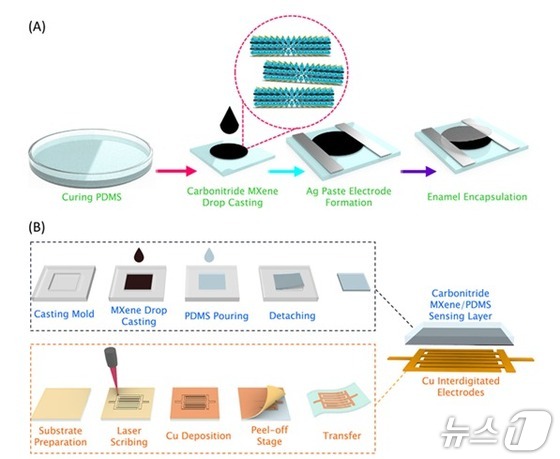
The team’s newly developed MXene (Ti₃CNTz) demonstrates a remarkable improvement in sensitivity, showing a threefold increase in response to temperature changes and a fourfold enhancement in detecting pressure stimuli compared to existing nitrogen-free materials.
This breakthrough was achieved by identifying the optimal nitrogen concentration. The nitrogen enhances electron density in specific regions and amplifies lattice vibrations, maximizing the material’s responsiveness to external stimuli.
Lattice vibrations occur when atoms within a material oscillate subtly within their regular arrangement. These vibrations influence electron movement and energy transfer, ultimately affecting the material’s electrical and optical properties.

The accordion-like structure of MXene has also been found to enhance its mechanical strength. This characteristic was confirmed through density functional theory (DFT) calculations and synchrotron-based X-ray absorption fine structure experiments.
Sensors crafted from this material have demonstrated an exceptional ability to differentiate between subtle vocal cord vibrations during various activities, including speaking, swallowing, and coughing, by detecting minute pressure changes.
The sensors have also shown versatility in capturing real-time eye blinks, recording pulse waveforms on the wrist, and analyzing gait patterns when attached to shoe heels.
Remarkably, these sensors can detect temperature changes without direct contact, functioning at distances of 1 to 2 mm. They can recognize temperature fluctuations by detecting infrared heat from smartphone camera flashes or through mere proximity.
Professor Kim emphasized the broad potential of this technology, stating that this innovation has applications beyond healthcare, extending to various cutting-edge fields such as energy storage, catalysis, and electromagnetic shielding.
The findings of this research were published online on April 12 in the renowned materials science journal Advanced Functional Materials.